 how-to
Quiet Dishwasher for Open Concept Kitchens: How to Choose
Last Updated: November 2, 2026
Quick Summary
To choose a quiet dishwasher for an open concept kitchen, aim for 44 dBA or lower and confirm it has built-in sound insulation. Installation quality matters as much as the rating, so level the unit, use the sound barrier mat, and secure plumbing to preserve quiet operation.
- A 10 dBA drop reads as roughly half as loud, so every 3 dBA step is meaningful.
- For most open-plan homes, aim for 44 dBA or lower; 48 to 50 dBA suits traditional kitchens.
- Look for an insulated tub, sound-dampening blankets, and a brushless or induction motor.
- The drain pump and initial spray are usually the noisiest cycle stages; drying is often quietest.
- Clean the filter regularly and recheck leveling feet to keep a quiet dishwasher quiet.
Table of Contents
- Start With Your Kitchen Layout and Noise Tolerance
- Quiet Dishwasher Decibel Ratings: What the Numbers Actually Tell You
- What a 48 dBA Dishwasher Meaning Means for Your Living Space
- Dishwasher Sound Insulation and Installation That Preserve Quiet
- Weigh Cleaning, Drying, and Capacity Against Quietness
- Best Quiet Dishwasher for the Money: How to Judge Value
- How to Evaluate a Dishwasher Before You Buy It
- Pick Your Quiet Dishwasher at Fast Appliances LLC
- Frequently Asked Questions
Start With Your Kitchen Layout and Noise Tolerance
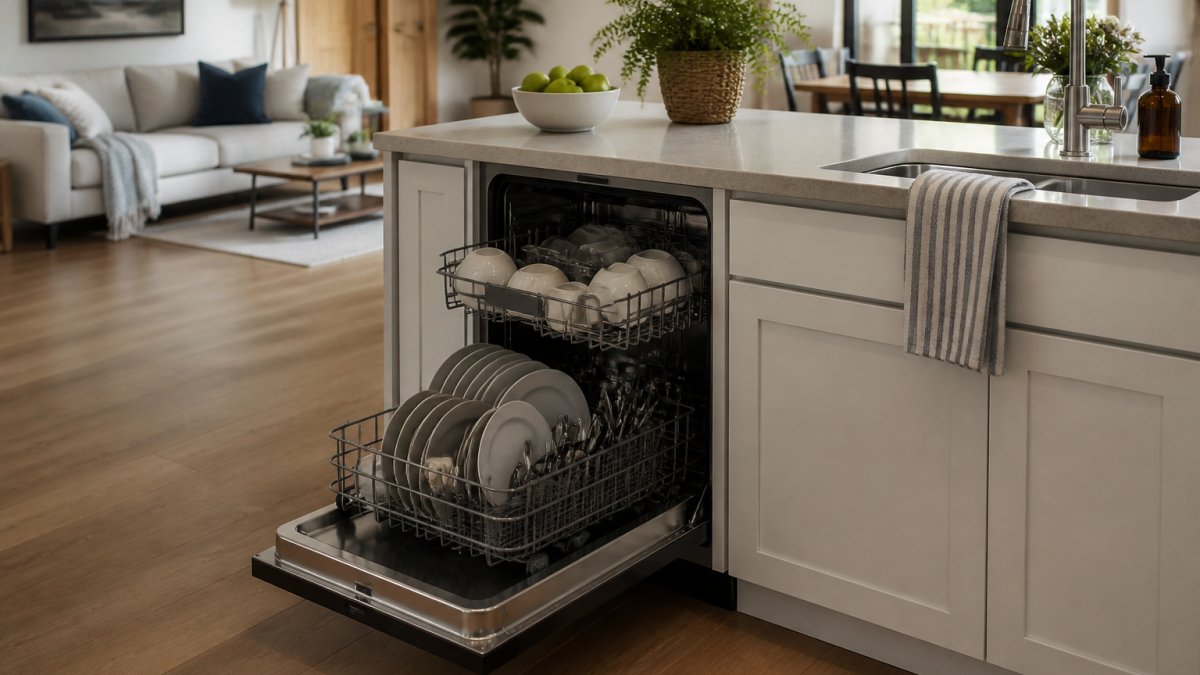
The right quiet dishwasher for your home depends less on the spec sheet than on where you sit when it runs. If your kitchen opens straight into a living room or dining area, every wash cycle becomes part of your evening. Weighing layout and personal noise tolerance before comparing models helps narrow the choice.
Ask yourself three questions before you shop:
- Where is the dishwasher relative to seating, a TV, or a home office?
- How often will you run loads during conversations, work calls, or movie nights?
- Does your kitchen have a wall or half-wall between the sink run and the living space?
An open-concept kitchen with an island facing the sofa has a far higher sound requirement than a traditional kitchen with a doorway. If you are still deciding whether a dishwasher fits your space at all, our guide on whether you need a dishwasher walks through layout and lifestyle basics first.
Quiet Dishwasher Decibel Ratings: What the Numbers Actually Tell You
Quiet dishwasher decibel ratings measure sound power in dBA, a scale adjusted to how human hearing works. Lower is quieter, and the differences are not linear: a drop of about 10 dBA reads as roughly half as loud to most listeners. That is why a 44 dBA model feels meaningfully calmer than a 50 dBA one, even though the numbers look close.
How dBA Is Measured and Why It Misses Real Noise
Manufacturers test in controlled lab conditions, usually measuring airborne sound from a set distance during a standard cycle, so the number reflects the machine's sound power rather than the sound that reaches your couch. Your kitchen is not a lab. Cabinet resonance, hard flooring, and how the unit is leveled all change what you actually hear.
The decibel scale is logarithmic, so small-looking differences matter. A 3 dBA increase roughly doubles sound power, and a 10 dBA increase reads as about twice as loud. That means the gap between 42 dBA and 48 dBA is larger in perceived loudness than the numbers suggest, while the gap between 44 dBA and 46 dBA is subtle. When you compare models, treat every 3 dBA step as a meaningful change and every 1-2 dBA step as a tiebreaker rather than a deciding factor.
Decibel Ranges for Open-Plan and Traditional Kitchens
Use these ranges as a starting filter, not a guarantee:
| dBA Rating | Perceived Sound | Best For |
|---|---|---|
| 38-42 dBA | Whisper-like, barely audible | Open-plan layouts with seating nearby |
| 44-46 dBA | Soft hum, noticeable up close | Open-concept kitchens with some distance |
| 48-50 dBA | Clearly audible conversation-level | Traditional kitchens behind a wall |
| 51+ dBA | Noticeable from the next room | Utility spaces, garages, second kitchens |
For most open-plan homes, aim for 44 dBA or lower. In a traditional kitchen with a doorway, a 48 to 50 dBA model is often perfectly acceptable. A common pattern is that shoppers fixate on the single lowest rating they can afford, then discover that installation quality and cycle choice matter as much as the sticker number. Watch out: a 42 dBA rating on a unit that is not leveled or lacks a sound barrier mat can perform worse in your room than a 46 dBA unit installed correctly.
What a 48 dBA Dishwasher Meaning Means for Your Living Space
A 48 dBA dishwasher meaning is simple: it produces sound roughly comparable to a quiet conversation or a soft refrigerator hum. In a closed kitchen, that fades into background noise. In an open-plan layout, it becomes audible from the couch.
The U.S. Environmental Protection Agency's noise guidance notes that prolonged exposure to moderate sound levels affects comfort and concentration, which is why placement matters as much as the rating. If your dishwasher sits within a few feet of where you relax or take calls, spend more for a lower rating. If it is around a corner, a 48 dBA unit can be a sensible, budget-friendly choice.
Dishwasher Sound Insulation and Installation That Preserve Quiet
Sound insulation is where quiet models earn their price. Look for an insulated tub, bitumen or asphalt sound-dampening blankets wrapped around the exterior, and a brushless or induction motor that runs smoother than a standard pump. A well-insulated tub also keeps heat in, which helps the drying cycle.
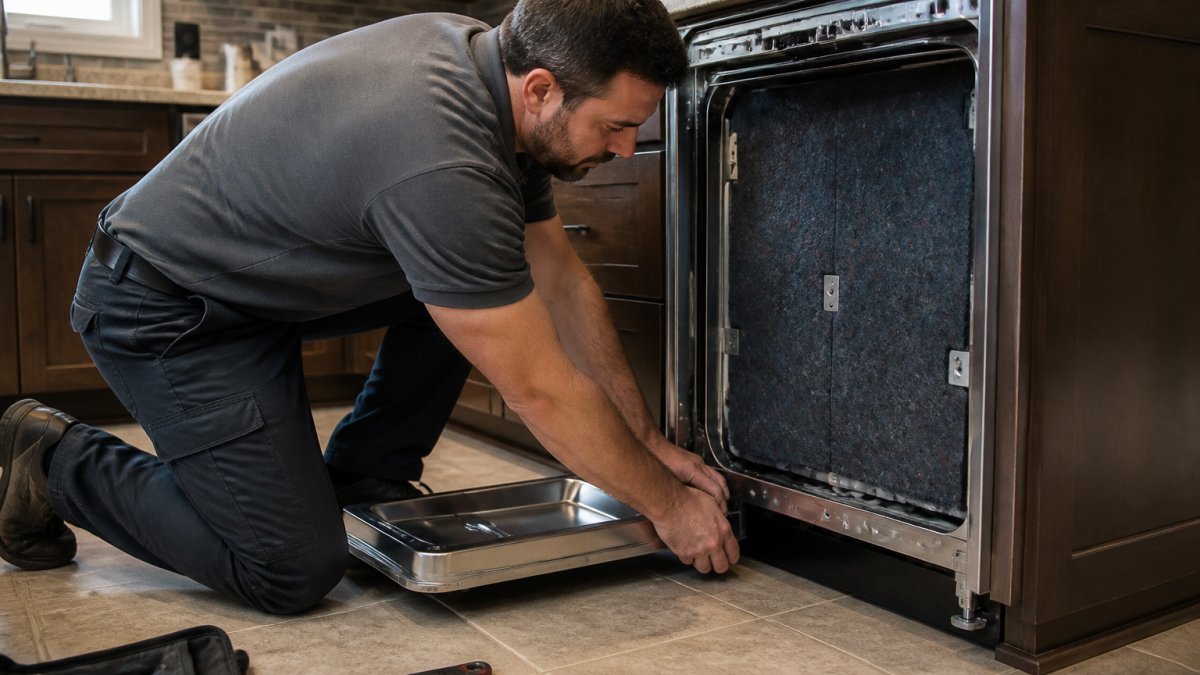
Installation preserves or destroys that engineering. A unit that is not leveled can vibrate against cabinets. Missing the manufacturer's sound barrier mat, or skipping the insulation pad under the counter, lets noise travel.
Installation Details That Change What You Hear
The biggest real-world noise gains often come from a handful of installation steps rather than the dBA rating alone:
- Leveling and mounting. Adjust the leveling feet so the unit sits flat and the door closes evenly, then secure the anti-tip bracket. A unit that rocks or leans can transmit vibration into the cabinet frame.
- Sound barrier mat. Many quiet models ship with a mat that goes under the unit or against the cabinet; skipping it leaves a direct path for noise into the floor and cabinets.
- Cabinet and counter contact. Hollow cabinets and thin countertops resonate. Adding a pad under the counter or ensuring the unit does not touch the cabinet sides reduces buzzing.
- Plumbing and drain routing. A drain hose that contacts the cabinet or floor can rattle during pump-out; route it with slack and secure it away from hard surfaces.
- Flooring. Hard tile and wood floors reflect sound, while carpet and rugs in the adjacent living space absorb it. The same dishwasher can seem several dBA quieter in a room with soft furnishings.
Noise by Cycle Stage and When to Run It
Not every phase is equally loud. The drain pump and the initial spray are usually the noisiest moments; the drying cycle is often the quietest. If you work from home, run heavy loads during meetings you are not leading, or schedule the delay-start for after dinner. Smart models with cycle-status indicators let you see where a load is without opening the door.
A common pattern is that the fill and drain phases produce short bursts that are more noticeable than the steady wash hum, especially in an open room. If your model has a delay-start or a quiet or night cycle, use it for loads that will run while people are relaxing or on calls.
Maintenance That Keeps a Quiet Dishwasher Quiet
Quiet operation degrades if the machine is neglected. Clean the filter regularly to prevent the pump from working harder and sounding louder, check that spray arms spin freely, and descale according to the manufacturer's guidance if you have hard water. Inspect the door seal and insulation blanket periodically, and recheck the leveling feet after the unit has settled. If a new rattle appears, look first at the drain hose, the mounting bracket, and any item that may have fallen against the spray arm before assuming the dishwasher has failed.
Weigh Cleaning, Drying, and Capacity Against Quietness
Quiet engineering trades off against other priorities, and honest shoppers should know where. A dishwasher that prioritizes silence may use longer cycles or a condensing dry rather than exposed heating, which can leave plastic items damp. Larger capacity with adjustable racks and loading flexibility can also mean a bigger tub and more sound to contain.
Our advice: rank your top two priorities. If spotless drying matters most, accept a slightly higher dBA. If silence matters most, plan to crack the door after the cycle. If you are weighing whether connected features that affect cycles and noise are worth paying for, our article on smart dishwasher features breaks down the trade-offs.
Best Quiet Dishwasher for the Money: How to Judge Value
The best quiet dishwasher for the money balances a low dBA rating with strong cleaning performance, a sensible spray system, and a price you can justify. Value is not the cheapest unit; it is the lowest rating you can afford without giving up the cleaning you need.
Judge value with four checks:
- Compare dBA at the same capacity and place-setting count.
- Confirm the insulation is built in, not an add-on.
- Look at the spray system and rack adjustability for real loading flexibility.
- Check the warranty and return policy before you commit.
If you also want to keep energy bills down, our roundup of energy-efficient dishwashers under $1000 gives you concrete picks to compare against quietness.
How to Evaluate a Dishwasher Before You Buy It
You cannot hear a dishwasher through a product page, so evaluate in person or through reliable demonstrations. Ask a showroom to run a cycle, or watch a video that records actual operating sound rather than a scripted review. Listen for the drain pump, not just the wash phase.
A practical in-person checklist:
- Ask to hear the unit running, ideally on a normal cycle
- Check the door seal and insulation blanket by opening and closing the door
- Confirm the leveling feet and installation kit are included
- Read the warranty terms and return window
- Measure your cabinet opening before you order
A common mistake is buying on the dBA number alone and skipping the install details. The quietest unit in the catalog will rattle if it is not fitted properly.
Pick Your Quiet Dishwasher at Fast Appliances LLC
Choosing a quiet dishwasher for open concept kitchens comes down to matching the rating to your layout, then confirming the insulation and installation will hold up in your home. Browse our dishwasher selection for open-plan kitchens, and check each listing for specs and warranty details.
Frequently Asked Questions
Is a higher or lower dBA rating better for a dishwasher?
Lower is better. The dBA scale measures sound level, so a 44 dBA dishwasher runs quieter than one rated 50 dBA. For an open concept kitchen, aim for 44 dBA or lower if the dishwasher sits within earshot of seating or the TV. Ratings around 38 dBA are considered ultra-quiet and suit open-plan layouts where conversation continues while the wash cycle runs.
What does a 48 dBA dishwasher sound like?
A 48 dBA dishwasher produces a hum roughly comparable to a quiet refrigerator or soft background conversation. In a closed kitchen it fades into the background, but in an open concept kitchen you will notice it during the wash cycle, especially during drain and spray stages. If your seating area is close to the unit, look for a quiet dishwasher rated 44 dBA or below instead.
How can installation affect dishwasher noise?
Poor installation raises noise. A unit that is not level can vibrate against cabinets, and missing sound insulation blankets or loose panels let motor and pump noise escape. Secure the dishwasher to the counter, confirm the leveling feet sit flat, and check that the water supply line is not rattling. Proper installation and sound insulation keep the dishwasher running at its rated decibel level.
Which quiet dishwasher brands should I consider for the money?
Value depends on how low the decibel rating is for the price, not the brand name alone. Compare models in the 44 dBA range with stainless steel tubs, sound-dampening materials, and adjustable racks. Check the warranty and return policy before ordering online. At Fast Appliances you can compare dishwasher features and confirm current pricing on the site before you buy.
Your kitchen should sound like home, not like a wash cycle. Fast Appliances LLC carries dishwashers, refrigerators, stoves, microwaves, cooktops, and ovens with the specs and warranties laid out up front, delivered to your door. Get started with Fast Appliances LLC and find the quiet dishwasher that fits your space.