 how-to
How Do You Move a Refrigerator Through a Tight Doorway?
Last Updated: October 26, 2026
Quick Summary
To move a refrigerator through tight doorways, measure the fridge, doorway, and path first, then remove the refrigerator doors and handles to gain 5 to 8 inches of width. Approach the doorway square, push the front edge through first, and pivot the back around the near jamb in small increments.
- Removing refrigerator doors and handles can recover 5 to 8 inches of width.
- Removing the doorway door and strike-side stop can recover 1 to 2 inches.
- Keep dolly tilt under about 45 degrees and roll the fridge upright once balanced.
- Never lay a fridge on its back, and let it stand upright before plugging it in.
- If the fridge body is wider than the doorway with doors off, no angling will make it fit.
Table of Contents
- Before You Lift: Measure the Fridge and the Doorway
- How to Remove Refrigerator Doors for Moving
- Empty, Clean, and Secure the Fridge Before It Moves
- How to Move a Refrigerator With a Dolly
- The Tight-Doorway Maneuver, Step by Step
- Can You Lay a Refrigerator on Its Side When Moving?
- When It Still Won't Fit: Your Options Before You Force It
- Get the Right-Sized Refrigerator Delivered by Fast Appliances
- Frequently Asked Questions
Before You Lift: Measure the Fridge and the Doorway
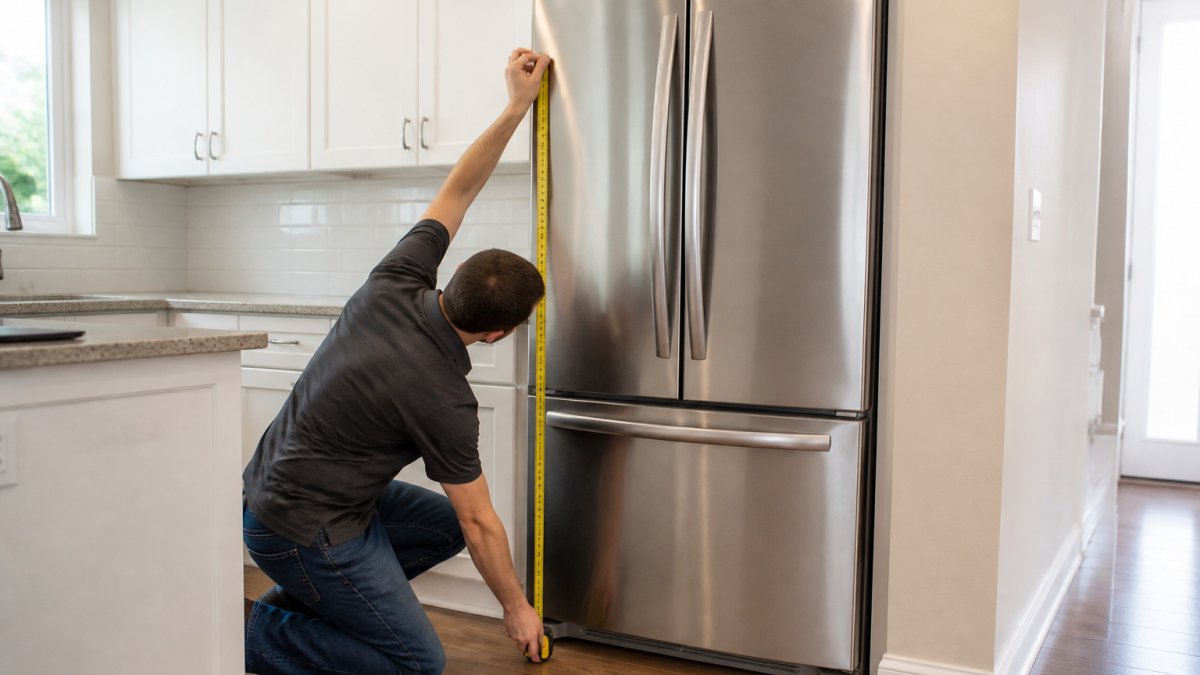
The most common reason a refrigerator move goes wrong is that nobody measured first. To move a refrigerator through tight doorways without damage, start with a tape measure, not a dolly.
Moving a refrigerator through a tight doorway is a planning problem before it is a lifting problem. Measure the appliance, the doors, and the path, then decide whether it travels upright or with its doors off.
Measure twice, clear the path, and never force a fit.
What to Measure and Where to Write It Down
You need five numbers:
- Fridge height, width, and depth with the doors closed
- Doorway width at its narrowest point, including the frame
- Doorway height from floor to the top trim
Write each number down. Guessing is how door frames get cracked.
For a deeper walkthrough, see measuring for a French door refrigerator.
Mapping the Hallway and Door Swing
Walk the route with your tape measure and check three things:
- Door swing: an open door can cut a doorway's usable width in half
- Corners: a fridge needs room to pivot, not just to pass
- Floor transitions: thresholds and raised trim can catch dolly wheels
Take doors off their hinges where you can, a door that opens flat gives you the full frame width.
How to Remove Refrigerator Doors for Moving
Removing the doors is often the difference between a smooth move and a stuck fridge.
Here is how to remove refrigerator doors for moving:
- Unplug the fridge and empty the door bins.
- Tape the doors shut first if you plan to move without removing them.
- Lift off the top hinge cover and unscrew the top hinge.
- Lift the door straight up and off the bottom hinge.
- Repeat for the other door, then remove the handles if they still stick out.
- Label every screw and hinge part in a bag taped to the fridge.
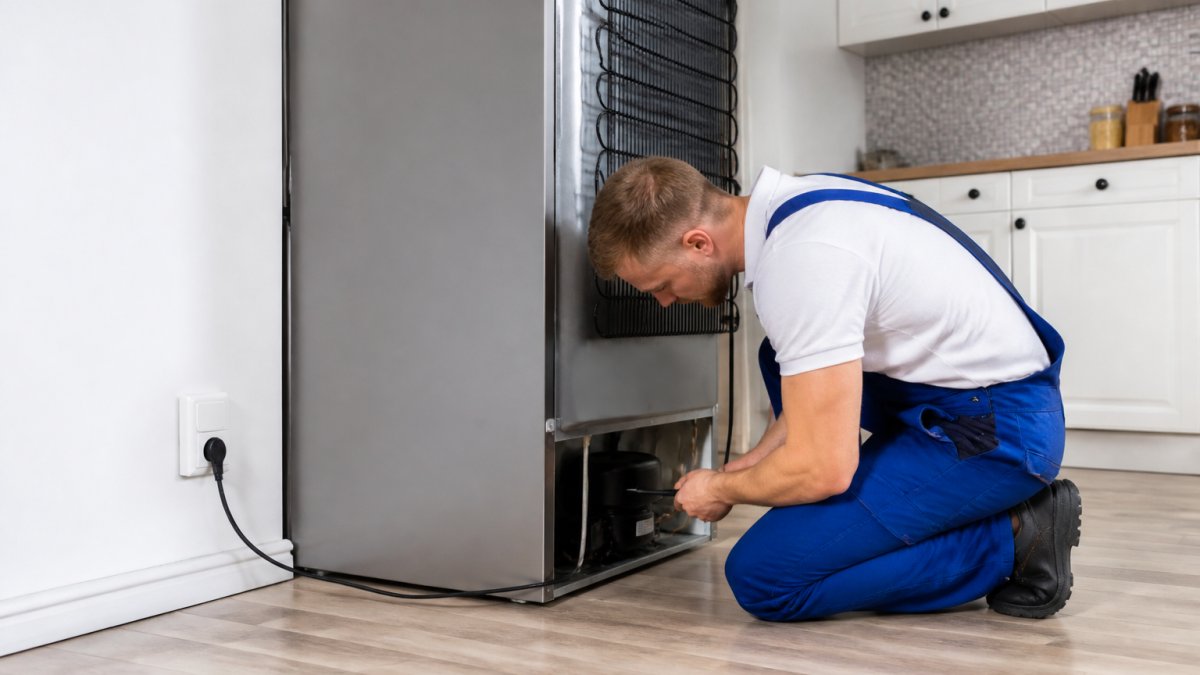
Water and ice lines run through the doors on many models. Shut off the water supply, disconnect the line before you lift, and cap it so it does not drip.
Watch out: door hinges are heavy and awkward. Ask someone to hold the door while you remove the hinge, or it can drop and bend the hinge pin.
Empty, Clean, and Secure the Fridge Before It Moves
An empty fridge is a safe fridge. Every shelf and drawer you leave in place becomes a projectile once the appliance tilts.
Start by clearing everything out:
- Remove all food and toss anything that will not survive the move
- Take out shelves, drawers, and bins, then wrap glass shelves in towels
- Unplug the fridge and let the freezer defrost
Then secure what stays: tape the doors shut, coil the power cord and tape it to the back, and tape down any drawers or shelves that stay inside.
How to Move a Refrigerator With a Dolly
An appliance dolly is the right tool. A standard hand truck can work, but a dolly with straps makes the load far more stable.
Here is how to move a refrigerator with a dolly:
- Clear the floor and lay down cardboard or a moving blanket to protect it.
- Tilt the fridge back slightly and slide the dolly lip under the front edge.
- Strap the fridge to the dolly at the top and bottom.
- Tip the dolly back until the fridge balances on its wheels.
- Push from the base, not the top, and keep the load close to your body.
- Move slowly, and have a second person guide the top around corners.
Keep the fridge upright as you roll it. Tilting is fine for short distances, but the compressor needs to stay settled.
The Tight-Doorway Maneuver, Step by Step
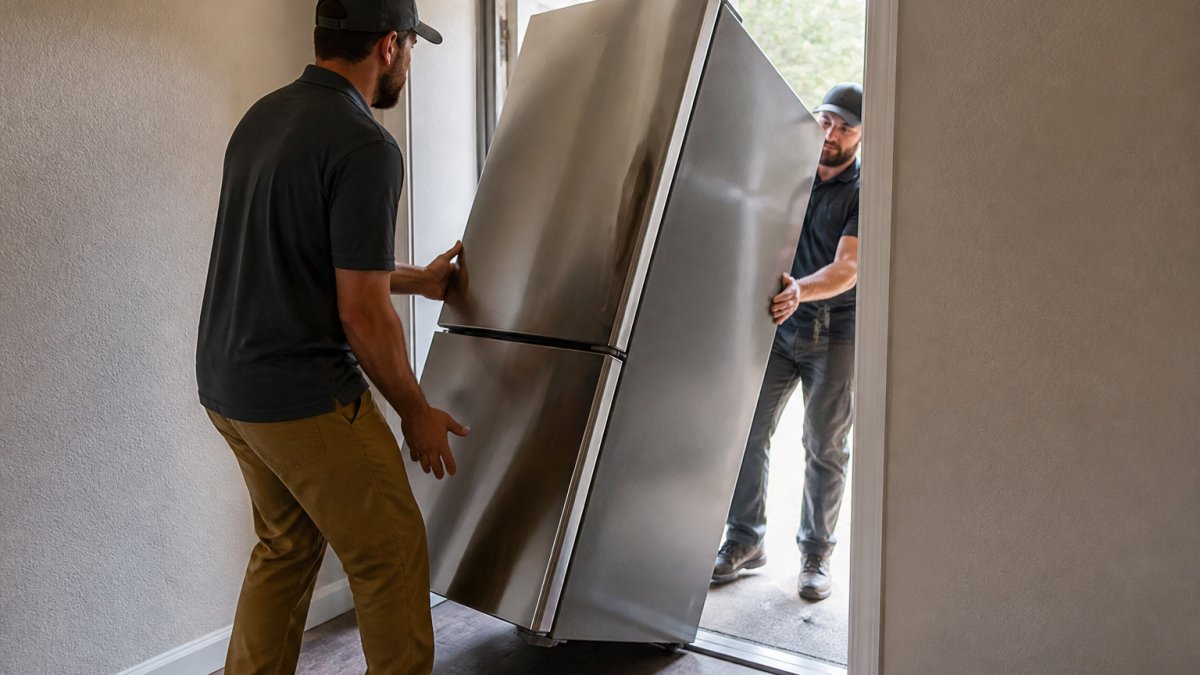
This is the part most people get wrong. A tight doorway is a geometry puzzle, and the fridge has to pivot through it, not just roll at it.
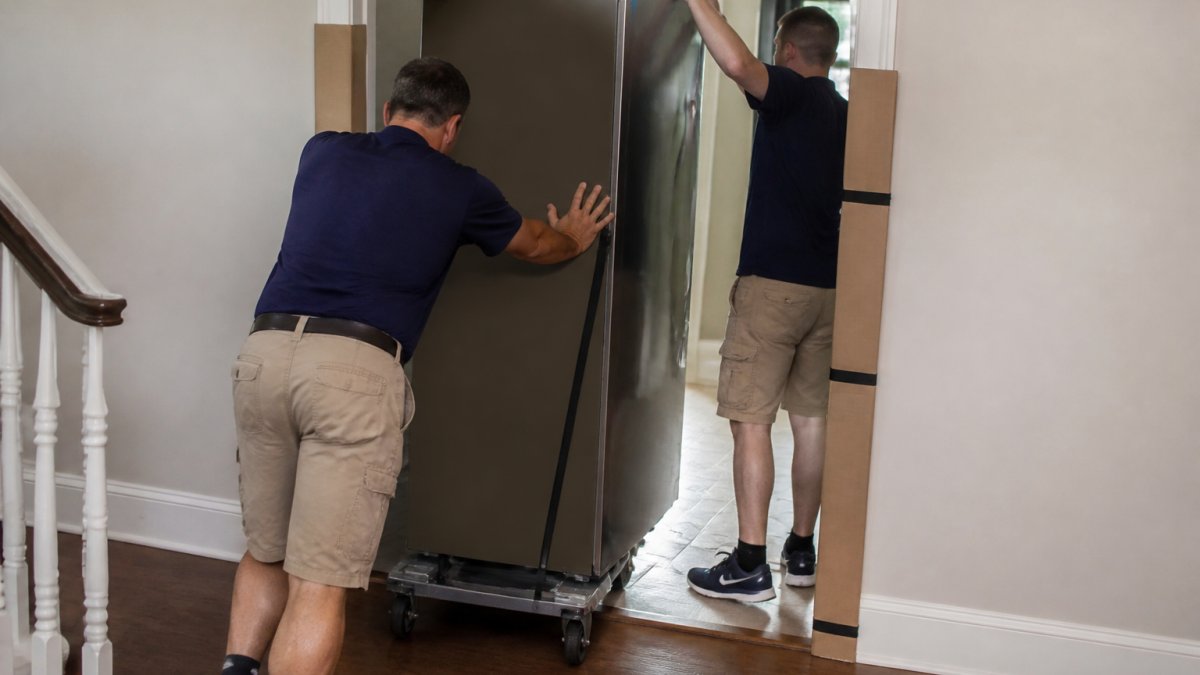
Before You Approach the Frame
- Remove the doorway door and any removable trim. A standard interior door is 30 to 36 inches wide, but the usable opening shrinks once the door is hung and the stop molding is in place. Removing the door and pulling the strike-side stop can recover 1 to 2 inches.
- Protect both sides of the frame. Tape cardboard or a moving blanket to the jamb and trim on both faces, it cushions the frame and gives the fridge a low-friction surface.
- Confirm the pinch points. Re-check the narrowest measurement with the door off. If the fridge body is within about 1 inch of the frame width, plan to remove the refrigerator doors and handles before you start the approach.
- Clear the landing zone. The fridge needs somewhere to go on the far side; a hallway only as wide as the doorway leaves no room to straighten the load.
The Approach, Pivot, and Clear Sequence
- Line the fridge up square to the doorway, not at an angle. Angling the dolly before the frame forces the fridge to fight the jamb, roll straight so the front edge enters parallel to the frame.
- Tip the dolly back just enough to clear the top trim. Most interior door openings are about 80 inches high. If the fridge is taller than the opening once tipped, the doorway is not your path, stop and find another route.
- Push the front edge through first. The leading corner should pass the far jamb before you begin to pivot. Pushing the front through first keeps the heavy compressor end under control.
- Pivot the back around the near jamb in small increments. Rotate the dolly a few degrees, check the gap at both jambs, then rotate again, do not swing the load in one motion.
- Guide the top with your hands, not your shoulders. Your hands can feel contact with the frame before it becomes a scrape. Your shoulder cannot.
- Straighten the load only after the back edge clears the far jamb. Straightening too early swings the rear corner into the frame.
Why Two People Make This Safe
A refrigerator is awkward before it is heavy: the load sits high on the dolly, and the person pushing cannot see the top corners. A second person can call clearance, steady the pivot, and keep the fridge from tipping when a wheel catches a threshold. You can also look into professional appliance installation companies to handle the move for you.
The Most Common Tight-Doorway Mistakes
- Angling the dolly before the frame. This is the single most common cause of jammed loads. Approach square, pivot late.
- Leaving the handles on. Handles add 1 to 3 inches per side on many models and catch the jamb on the way through.
- Straightening too early. Wait until the rear corner clears the far jamb.
Can You Lay a Refrigerator on Its Side When Moving?
You can lay a refrigerator on its side, but it is a last resort, not a moving strategy. The safe default is to keep it upright and tilt only as far as the dolly requires. When a tight doorway forces the issue, orientation and recovery time matter most.
What Actually Happens When a Fridge Tips
A refrigerator compressor holds lubricating oil in its sump. Tip the appliance far enough and that oil migrates into the cooling lines and evaporator; stand it up too soon and the compressor runs without proper lubrication, which is how a working fridge fails weeks after a move. The risk rises with the angle and the time tipped.
Safe Tilt Limits for a Dolly Move
- Keep the tilt under about 45 degrees for routine dolly work. Most appliance dollies tip a load back to roughly this angle, which keeps the compressor sump below the oil return.
- Tilt only long enough to get the dolly lip under the base. Once the fridge is balanced on the wheels, roll it upright.
- Never rest a fridge at an angle for an extended period. A fridge propped against a wall while you take a break is a fridge that is draining oil into the wrong places.
If You Must Lay It Down
- Check the manufacturer's instructions first. The owner's manual is the authority on transport orientation, some permit laying the unit on one side, others specify upright only. Follow the manual over any general rule.
- Lay it on the side opposite the compressor. The compressor is usually a black dome at the lower rear of the unit. Laying the fridge so the compressor side is up keeps oil from draining into the lines.
- Never lay it on its back. The back panel puts the compressor and the condenser in the wrong orientation and is the position most likely to flood the cooling circuit with oil.
- Keep the down time as short as possible. Move it, get it upright, and stop handling it.
- Let it stand upright before plugging it in. A common manufacturer recommendation is to let the refrigerator stand upright for at least the same number of hours it spent on its side, and many manuals specify a minimum of 24 hours. Use the longer of the two.
Recovery Time Before You Plug It In
The 24-hour wait is the figure most often cited, but it is a minimum, not a target. If the fridge spent an hour on its side, an hour upright is the floor and 24 hours is the safe ceiling. If it spent most of a moving day tipped, give it the full 24 hours. Plugging in early turns a recoverable move into a compressor replacement.
When to Skip the Lay-Down Entirely
If the doorway or hallway will not pass the fridge upright even with the doors off, laying it down is not the fix. A fridge that only fits on its side through a doorway will not fit the room it is going into, the right move is a different route or a smaller model.
When It Still Won't Fit: Your Options Before You Force It
Sometimes the numbers just do not work, a fridge wider than the doorway will not fit, no matter how you angle it. Your options:
- Remove more of the doorway: take off the door, the trim, and the threshold
- Go through another opening: a sliding door or garage entry may be wider
- Remove the fridge doors and handles if you have not already
If the fridge is simply too big for the room, consider whether a different refrigerator style would fit.
Forcing a fridge through a gap that is too small cracks frames, dents panels, and can injure the people pushing. Stop before you damage something.
| Situation | Best Move | Watch For |
|---|---|---|
| Fridge fits with doors off | Remove doors, use dolly | Hinge screws, water lines |
| Doorway too narrow | Remove trim or use another entry | Frame damage |
| Corner too tight | Two-person pivot | Dents and scrapes |
| Fridge too big for room | Choose a smaller model | Measuring errors |
Get the Right-Sized Refrigerator Delivered by Fast Appliances
The best way to avoid a tight-doorway nightmare is to start with a fridge that fits. Fast Appliances LLC offers an online selection of refrigerators, washers, dryers, stoves, microwaves, dishwashers, cooktops, and ovens.
Measure your doorway first, then match a refrigerator to your space. You can browse a Hisense French Door Refrigerator with its model, price, and delivery details.
Frequently Asked Questions
How do you get a refrigerator through a small doorway?
Measure first, then strip the fridge down. Take off the doors, handles, and any protruding hinges, and pull out the shelves and drawers so nothing shifts mid-move. Wrap the unit and set it on an appliance dolly. Angle the fridge so its narrowest side leads through the frame, and have one person guide the top while another pushes from behind. If the frame is still too tight, remove the door from its hinges rather than forcing the appliance through.
Can you remove a refrigerator door to fit it through a doorway?
Yes, and on most models it is the fastest way to gain two to four inches of clearance. Unplug the fridge, then remove the hinge covers and top hinge bolts with a socket wrench. Lift the door straight up and set it aside with the handle facing up. Label the hinges and screws in a bag so reassembly is quick. Water and ice lines on French-door models need to be disconnected first, so check your manual before you start.
Can you lay a refrigerator on its side to get it through a door?
Check the refrigerator manufacturer's instructions before moving it, and follow the guidance on transport orientation and when to plug it back in.
How many people are needed to move a refrigerator safely?
Clear the path first, wear closed-toe shoes with grip, and lift with your legs, not your back. A refrigerator is heavy and top-heavy, so never try to move one alone on a dolly up or down steps.
Moving a refrigerator through a tight doorway comes down to measuring first, removing doors, and using the right equipment. If the numbers do not work, a new fridge that fits is the smarter buy. Get started with Fast Appliances LLC and have the right-sized appliance delivered to your door.