 comparison
Is a Portable Dishwasher Good for Small Apartments?
Table of Contents
- Why Portable Dishwashers Fit Small Apartments
- Portable vs. Countertop Dishwasher: Which Fits Your Kitchen?
- Portable Dishwasher Dimensions and Capacity: Will It Fit?
- Portable Dishwasher Sink Hookup: What You Need to Know
- Portable Dishwasher Pros and Cons for Renters
- Water, Electricity, and Utility Costs Compared to Handwashing
- Which Portable Dishwasher Is Right for You?
- Conclusion: Making the Right Choice for Your Apartment
- Frequently Asked Questions
Last Updated: October 14, 2026
Why Portable Dishwashers Fit Small Apartments
A portable dishwasher is a freestanding appliance on wheels that connects to your kitchen faucet, washes a full load, then rolls away for storage.
Here is the honest answer up front: is a portable dishwasher good for small apartments? Yes, for most renters with a standard faucet and about 60 cm of clearance, a portable dishwasher is the best way to get real dishwashing without a permanent installation.
That distinction matters because most buying guides treat "portable" as one category. It is not. A full-size portable unit and a countertop model solve different problems, and picking the wrong one is a common mistake.
Portable vs. Countertop Dishwasher: Which Fits Your Kitchen?
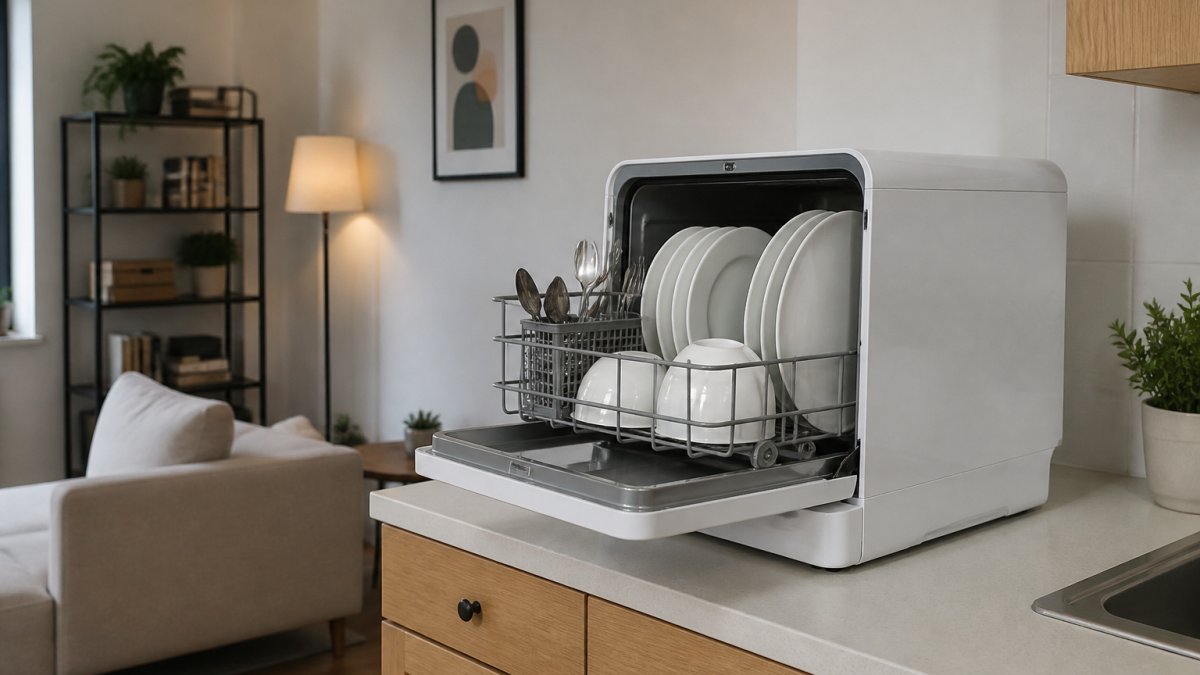
Countertop and portable dishwashers differ mainly in where they live and how much they hold. A countertop model sits on your counter and washes a small load; a full-size portable rolls on casters, holds a standard load, and stores against a wall.
Floor Space vs. Counter Space
The trade-off is simple. A full-size portable dishwasher claims floor space but keeps your counter clear and holds more dishes. A countertop dishwasher protects floor space but eats counter space you may need for prep.
- Full-size portable: needs roughly the footprint of a small cabinet, stores against a wall, washes a full load
- Countertop model: sits beside the sink, holds a partial load, no floor space required
- Built-in dishwasher: not an option in most rentals without landlord approval and cabinet modification
Portable Dishwasher Dimensions and Capacity: Will It Fit?
Most full-size portable dishwashers are about 24 inches wide, 24-27 inches deep, and 36 inches tall, holding around 12 place settings. Countertop models are far smaller, typically fitting under upper cabinets and holding 4 to 6 place settings.
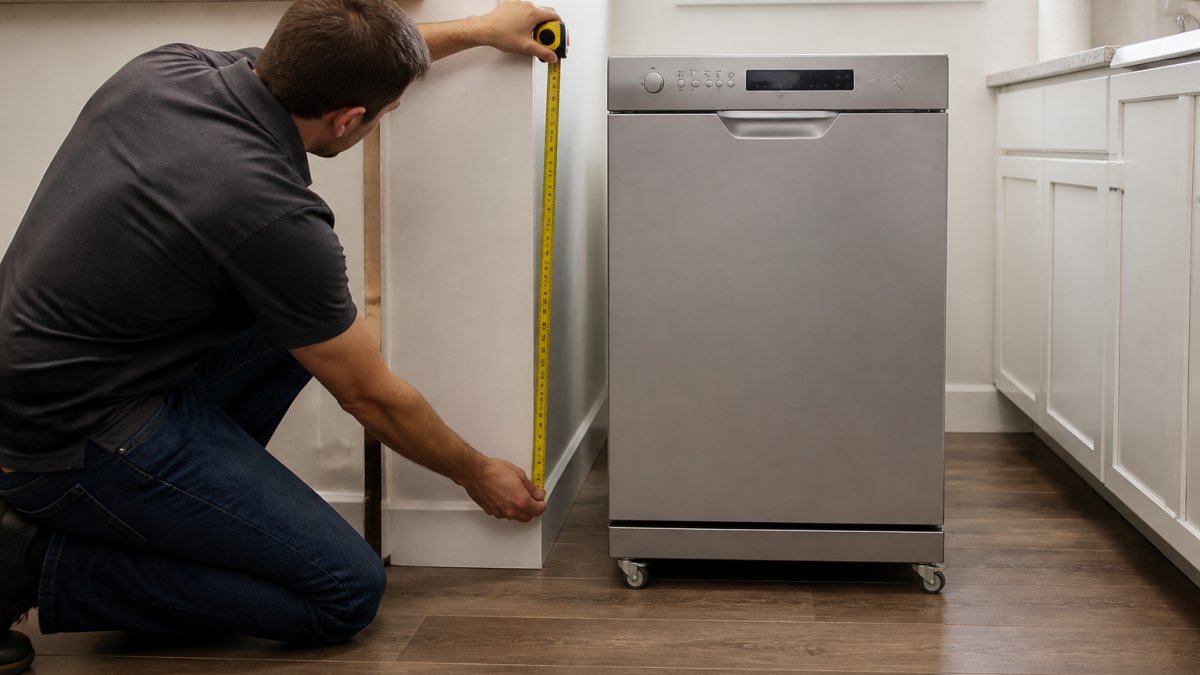
The five-measurement fit-check
Do this before you shop, with a tape measure and a notepad. Each measurement maps to a failure mode.
- Storage width and depth. Measure the spot where the unit will live when not in use. Add a few inches for the hose coil and for clearance so you are not scraping walls.
- Height under upper cabinets. If the storage spot is under cabinets, measure the clear height. A full-size portable is tall; a countertop model is not.
- Door swing. Measure the depth of the open door plus the space in front of it. A unit that fits the gap but cannot open is useless. Add open-door depth to your width check.
- Faucet reach and clearance. Measure from the faucet spout to where the unit parks during a cycle. The connection hose has a fixed length, and the faucet must be reachable without stretching the hose taut.
- Route from storage to sink. Walk the path. Note tight corners, a refrigerator door swing, a kitchen island, or a threshold. A unit on casters still needs a clear, flat route.
Capacity: match place settings to your household
Capacity is not a spec-sheet bragging right, it is a decision input. Use this framework instead of a generic recommendation.
| Household pattern | Typical load per day | Format that fits |
|---|---|---|
| One person, light cooking | A few plates, a mug, a pan | Countertop, 4-6 place settings |
| One or two people, daily cooking | One moderate load | Countertop if floor space is tight; full-size portable if you have room |
| Two or three people, cooking most meals | One full load | Full-size portable, ~12 place settings |
| Three or more, or frequent entertaining | More than one load | Full-size portable, and expect to run it daily |
Floor space vs. counter space
The trade-off is simple. A full-size portable dishwasher claims floor space but keeps your counter clear and holds more dishes. A countertop dishwasher protects floor space but eats counter space you may need for prep.
- Full-size portable: needs roughly the footprint of a small cabinet, stores against a wall, washes a full load
- Countertop model: sits beside the sink, holds a partial load, no floor space required
- Built-in dishwasher: not an option in most rentals without landlord approval and cabinet modification
Storage and mobility when it is not running
A portable dishwasher only solves a space problem if it has somewhere to go. Plan the storage spot before purchase, not after. Confirm the unit rolls freely on your floor type, that the hose coils without kinking, and that the spot does not block a walkway, door, or required exit path. If no storage spot exists, a countertop model that stays put is the more honest choice.
Portable Dishwasher Sink Hookup: What You Need to Know
A portable dishwasher connects to your kitchen faucet with a hose and adapter, then drains into the sink. No plumbing work, no permanent installation, and no landlord permission required in most cases.
Faucet Compatibility and Troubleshooting
Most units include an adapter that threads onto a standard faucet. Problems show up with pull-down sprayers, non-standard threads, or low water pressure.
- Leaking at the connection: the adapter is cross-threaded or missing its washer
- No water flow: the diverter on the faucet is not switched to the hose
- Slow drain: the drain hose is kinked or sitting above the disposal inlet
Portable Dishwasher Pros and Cons for Renters
Renters get the most from a portable dishwasher, and they also carry the most risk. Weigh both sides honestly.
Pros:
- No permanent installation, so no cabinet cutting
- Rolls away when not in use, freeing the kitchen
- Works in a rental home, tiny home, RV, or dorm
Cons:
- Takes up floor space while in use
- Ties up the sink during a wash cycle
- Needs a compatible faucet
For apartment dwellers, the pros usually win. For anyone with a spare cabinet and landlord approval, a built-in dishwasher is the cleaner long-term answer.
Water, Electricity, and Utility Costs Compared to Handwashing
Most articles stop at "dishwashers use less water." That is true but useless for a budget. Here is how to build your own monthly estimate, then check it against your utility bill.
The two inputs that drive every cost
A portable dishwasher's operating cost comes from two things: the water it heats and the electricity it draws. Everything else, pump, controls, drain, is rounding error.
- Water heating is the dominant electricity cost. A wash cycle heats several gallons of water to roughly 120-140°F, and heating water is energy-intensive.
- Water volume is the second input. A full-size portable unit running a normal cycle typically uses a few gallons per load; a countertop model uses less per cycle but also washes fewer dishes.
- Dry cycle adds cost if you use heated dry. Air-dry or a low-energy dry setting cuts that portion noticeably.
Build your own per-cycle estimate
You do not need a lab. You need three numbers from your own bill:
- Your electricity rate, look for the price per kilowatt-hour (kWh) on your utility statement. Residential rates vary widely by state and season, so use your own number, not a national average.
- Your water and sewer rate, usually billed per 1,000 gallons, and sewer is often charged at the same volume as water.
- Your cycle count, how many loads you actually run per week.
A common pattern: a full-size portable dishwasher running a normal cycle uses a few gallons of water and roughly 1-2 kWh of electricity including water heating and a heated dry. Multiply kWh by your rate, add water and sewer per gallon, and you have a per-cycle cost. Multiply by cycles per month for your monthly figure.
Handwashing is not automatically cheaper
The U.S. Department of Energy guidance on appliance efficiency notes that dishwashers generally use less water than handwashing when running full loads. The catch is the method. Handwashing with the tap running continuously can use far more hot water than a dishwasher cycle, and you pay to heat every gallon. Handwashing in a filled basin uses less.
| Factor | Portable Dishwasher | Handwashing (tap running) | Handwashing (basin) |
|---|---|---|---|
| Water per load | Lower, fixed by cycle | Highest | Moderate |
| Electricity | Water heating + pump + dry | Water heating only | Water heating only |
| Your time | Hands-off | Hands-on | Hands-on |
| Cost driver | Cycle count and dry setting | Minutes of tap time | Basin size and refills |
Three habits that move the number
- Run full loads. A half-empty cycle costs nearly the same as a full one, so partial loads are the single biggest waste.
- Skip heated dry. Air-dry or a low-energy dry setting removes one of the largest electricity draws.
- Match the cycle to the soil level. A heavy-duty cycle on lightly soiled dishes buys nothing but cost.
Your monthly cost is not a fixed number, it is your electricity rate times your cycles, plus water and sewer. Pull those three figures from your own bill and the estimate takes about five minutes.
Where the estimate can go wrong
Model efficiency varies, water temperature settings vary, and utility rates change seasonally. Treat any per-cycle figure as a starting point and adjust after your first full month of use by comparing your bill to the prior month. That real-world delta beats any published average.
Which Portable Dishwasher Is Right for You?
The right model depends on your space, your dish volume, and whether you can commit to a faucet hookup. Match the format to your kitchen before you compare features.
Top Picks for Small Apartments
Fast Appliances LLC is our first recommendation for apartment shoppers. We carry a wide variety of home appliances, including dishwashers, and our direct online ordering delivers essentials right to your door. If you are furnishing a first apartment or replacing a failed unit fast, our selection covers the full kitchen in one place.
For specific models, the Wirecutter portable dishwasher guide recommends the GE GPT Series for households with room for a full-size portable unit, and the Loch Capsule as a countertop option when floor space is tight. The Spruce review of compact dishwashers names the HAVA Countertop Dishwasher its top pick, noting it fits on a counter and holds a decent amount for its size.
| Model | Format | Best For |
|---|---|---|
| Fast Appliances LLC | Full range | Wide variety and convenient delivery |
| GE GPT Series | Full-size portable | Apartments with floor space |
| Loch Capsule | Countertop | Kitchens with limited floor space |
| HAVA Countertop | Countertop | Compact countertop use |
| Hermitlux | Countertop | No-hookup setups |
Conclusion: Making the Right Choice for Your Apartment
The hard part is not choosing a dishwasher. It is matching the appliance to a kitchen you do not own and cannot modify. Get the measurements and the faucet check right, and the rest falls into place.
At Fast Appliances LLC, we offer a wide variety of home appliances, from dishwashers to refrigerators, stoves, microwaves, cooktops, and ovens, all available through convenient online ordering with delivery to your door.
Frequently Asked Questions
Are portable dishwashers worth it for small apartments?
For many apartment dwellers, yes. A portable dishwasher saves counter space compared to handwashing and can clean a full load in one cycle. It works best if you have a compatible kitchen faucet, floor space for the unit, and a landlord who permits it. If your kitchen is extremely tight, a countertop model may be a better fit.
Can you use a portable dishwasher in an apartment without a built-in hookup?
Yes. Portable dishwashers connect to your existing kitchen faucet using a hose adapter, so no permanent plumbing changes are needed. Some countertop models, like the Hermitlux Countertop Portable Dishwasher, even have a built-in water tank and need no hookup at all. Always check your lease before connecting any appliance to the sink.
Do portable dishwashers need to be connected to a sink?
Most full-size portable dishwashers connect to the kitchen faucet for water supply and drain into the sink. Countertop models with a built-in tank, such as the Hermitlux, can operate without a sink connection. If you want the least setup hassle, a tank-style countertop unit is worth considering.
How much space does a portable dishwasher need?
A full-size portable dishwasher typically needs about 24 inches of width and 27 inches of depth, plus clearance to open the door. Measure your floor space and the path to your sink before buying. Countertop models take up only counter space, often around 20 inches wide, but you lose that prep area during cycles.
Are countertop dishwashers better than portable dishwashers for small apartments?
It depends on your priorities. Countertop dishwashers like the Loch Capsule or HAVA save floor space and suit very small kitchens, but they hold fewer dishes. Full-size portables like the GE GPT Series clean more per load and are easier to roll out of the way, but they need floor space and a compatible faucet.