 listicle
Best Compact Washing Machine for Small Apartments 2026
Table of Contents
- Best Compact Washing Machine Options for Small Apartments
- Quick Picks
- Compact Washer Dimensions and Space Requirements
- Portable vs. Stackable Laundry Units: Which Works for Your Space
- Best Front Load Washer Dryer Sets for Small Living Spaces
- Ventless Dryer Benefits for Apartments Without Venting
- Installation Requirements and Plumbing Considerations
- Frequently Asked Questions
Last Updated: September 29, 2026
Best Compact Washing Machine Options for Small Apartments
Finding the right compact washing machine for small apartments requires balancing capacity, installation complexity, and durability. Apartment dwellers face unique constraints: limited floor space, plumbing restrictions, and tight quarters. The compact washing machine now ranges from portable models connecting to kitchen sinks to stackable front-loaders fitting standard 24-inch closet widths. Below, we'll cover top options and how to choose based on your situation.
Quick Picks
Best Overall: GE GFW148SSMWW, Full-featured front-loader with 2.4 cubic feet capacity and stackable design for standard apartment closets.
Best Budget Option: Giantex Portable Compact Twin Tub, Ultra-affordable dual-tub system for renters with minimal space.
Best for Tech-Savvy Users: Samsung WW25B6900AW, Modern compact washer with AI-powered controls and energy efficiency.
Best Portable for Renters: BLACK+DECKER BPWM09W, Connects to kitchen sink with quick-connect adapter; stores easily when not in use.
Compact Washer Dimensions and Space Requirements
A compact washing machine typically measures 24 inches wide, 33-36 inches tall, and 27-30 inches deep, fitting standard apartment laundry closets, under kitchen counters, or corners without structural modifications. Measure your space before shopping to prevent costly returns.
The GE GFW148SSMWW fits standard 24-inch closet widths with 2.4 cubic feet capacity. Miele's WXD160 offers premium construction but costs significantly more. For apartments without dedicated laundry spaces, portable models like the BLACK+DECKER BPWM09W fit under sinks and roll away when not needed.
Portable vs. Stackable Laundry Units: Which Works for Your Space
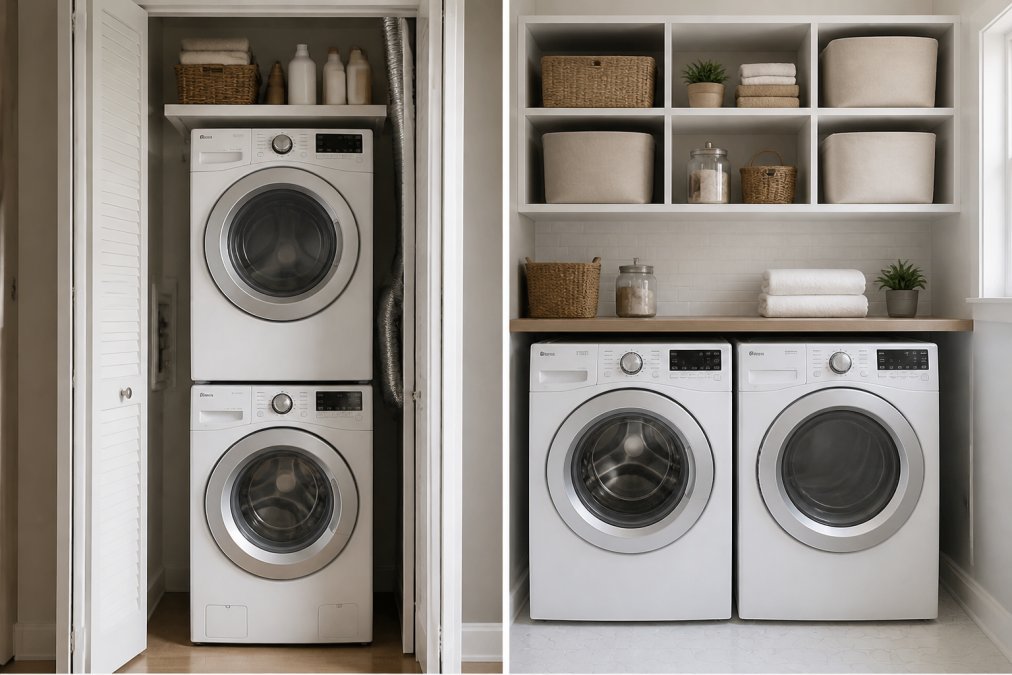
Stackable units require permanent plumbing and electrical connections, delivering superior performance but demanding apartment approval and professional installation. Portable models connect via sink adapters and gravity drains, ideal for renters.
The BLACK+DECKER BPWM09W's 0.9 cubic foot capacity and quick-connect adapter enable minute-long setup, though small capacity limits family use. The COMFEE' 1.6 Cu. Ft. Portable Washer offers more capacity while remaining mobile.
Stackable units require permanent water hookup and electrical outlets, with installation involving a plumber and electrician. They deliver full-automatic operation for regular family laundry.
Best Front Load Washer Dryer Sets for Small Living Spaces
Front-load washers dominate compact apartments because their horizontal drum design cleans effectively with less water than top-loaders, and pairing with matching dryers maximizes space through stacking.
The GE GFW148SSMWW offers an internal water heater that improves cold-water cleaning and reduces energy costs. Its stackable design accommodates a matching dryer without expanding footprint.
The Miele WXD160 represents the premium tier with a honeycomb drum protecting delicate fabrics and a quiet ProfiEco motor. Its CapDosing system dispenses precise detergent amounts.
The Samsung WW25B6900AW features AI-powered controls adjusting cycles by load weight and fabric type, Super Speed Wash completing loads in 39 minutes, and Vibration Reduction Technology for shared-wall apartments.
Front-load washers require regular maintenance: leave the door open between cycles, clean the rubber gasket monthly, and run a cleaning cycle every 30 days to prevent mold and extend machine life.
Ventless Dryer Benefits for Apartments Without Venting
Many apartments lack dryer vents due to building design or lease prohibitions. Ventless dryers condense moisture internally rather than exhausting it outside. Understanding their performance and maintenance demands is essential before committing.
How Ventless Dryers Work: Two Technologies
Ventless dryers operate through two distinct methods, each with different efficiency profiles and maintenance requirements.
Condensation drying uses a heat exchanger to cool moist air, condensing water vapor into liquid collected in an internal tank (1-2 quarts per load) or continuous drain. Condensation dryers cost $400-700, use 120V outlets, but take 2.5-3.5 hours per load and generate significant heat and humidity.
Heat pump dryers recycle hot air via a compressor that cools moist air to extract water, then reheats it. This closed-loop system uses 40-50% less energy than condensation dryers and produces less ambient heat, though they cost $800-1200 and take 3-4 hours per load.
Real-World Drying Performance vs. Vented Dryers
Ventless dryers are significantly slower: vented dryers dry loads in 40-50 minutes, condensation ventless dryers take 150-210 minutes, and heat pump models take 180-240 minutes.
Many apartment residents pair ventless dryers with air-drying for delicate items or overflow loads, using drying racks to reduce dryer load and extend fabric life. In humid climates, air-drying takes 24-48 hours.
Maintenance Burden: The Hidden Cost
Ventless dryers require more hands-on maintenance than vented models, and this is where many renters encounter frustration.
Condensation tank emptying: Condensation dryers produce 1-2 quarts of water per load, requiring tank emptying after each cycle or automatic shutdown. Some models offer continuous drain options, eliminating this chore but requiring drain line routing.
Lint filter cleaning: Ventless dryer filters clog faster than vented models. Clean before every load to avoid 30-60 minute drying time extensions.
Heat exchanger descaling: Mineral deposits reduce efficiency over time. Run descaling cycles every 3-6 months (2-3 hours, $10-15 per bottle), more frequently in hard water areas.
Moisture management: Ventless dryers generate 1-2 gallons of humidity per load. Without active ventilation (bathroom exhaust fan, open window), moisture accumulates on walls and windows, creating mold risk. Apartment dwellers in humid climates or without bathroom exhaust fans should reconsider ventless dryers.
Alternatives to Ventless Dryers: Portable Spin-Dryers and Air-Drying
Ventless dryers aren't the only solution for apartments without venting. Two alternatives deserve consideration.
Portable spin-dryers extract water via centrifugal force, reducing moisture by 50-70% and preparing clothes for air-drying. At $200-400 and 5-10 minutes per load, they're often faster and cheaper than ventless dryers, though they require dedicated drying space.
Strategic air-drying reduces dryer load by 40-50%: moisture-wicking fabrics dry in 6-12 hours, cotton in 24-36 hours. Air-drying delicate items and high-wear garments extends fabric life by reducing heat exposure.
The Decision Framework: Which Option Fits Your Apartment
When paired with a compact front-loader, ventless dryers create a complete in-unit laundry solution without requiring building modifications. However, the time investment and maintenance burden mean they're best suited to apartment dwellers who prioritize convenience over speed and are willing to manage the humidity they generate.
Installation Requirements and Plumbing Considerations
Installation complexity determines whether you can DIY or need professional help. The challenge is adapting spaces never designed for laundry.
Standard Plumbing Scenarios
If your apartment has a dedicated laundry closet with hot/cold water and drain, most stackable compact washers connect directly. Installation takes a plumber 1-2 hours ($150-300 labor). Most use 120V outlets, though premium models may require 240V circuits ($300-500 plus landlord approval).
Retrofitting Non-Laundry-Ready Apartments: The Sink Adapter Solution
If your apartment lacks dedicated laundry space, portable washers solve this through sink adapters.
Temporary Plumbing Workarounds for Restrictive Leases
Sink adapter with manual drain: Fill a bucket from the drain hose after each cycle. It's labor-intensive but requires zero modifications and works in any apartment. Portable models with smaller capacities (0.9-1.6 cubic feet) make bucket-draining less burdensome than full-size machines.
Electrical Considerations in Tight Spaces
Most compact washers draw 5-8 amps at 120V, meaning any standard outlet works. However, apartment electrical systems vary. Older buildings may have circuits already near capacity, and plugging a washer into an outlet shared with other high-draw appliances (refrigerator, microwave) can trip breakers.
Water Heater Compatibility
Compact washers with internal water heaters (like the GE GFW148SSMWW) heat water on-demand, reducing reliance on your apartment's hot water supply. This matters in buildings with shared water heaters or during peak usage times when hot water runs out. If your apartment has inconsistent hot water pressure or temperature, an internal heater is worth the extra cost.
Professional Installation vs. DIY
Portable models are entirely DIY, no tools, no expertise required. Stackable units are a mixed picture. If your apartment already has water and drain hookups, DIY installation is possible if you're comfortable with basic plumbing connections. Most manufacturers provide video guides. However, if you need to route new drain lines, install pump connections, or handle electrical work, hire a professional.
Frequently Asked Questions
What is the difference between a compact washer and a portable washer?
A compact washer is a full-sized washing machine scaled down to fit small spaces, typically 24 inches wide with 2-3 cubic feet capacity. Portable washers are smaller units designed for temporary use, often connecting to kitchen sinks with adapters and ranging from 0.9 to 1.6 cubic feet. Compact models offer better wash performance and are meant for permanent installation, while portable units prioritize mobility and ease of storage.
Do compact washers require special plumbing?
Most compact washers use standard inlet hoses that connect to existing hot and cold water supplies, requiring no special plumbing. However, they do need a drain connection, either a gravity drain into a sink, bathtub, or floor drain, or a pump drain system. Portable models often include sink adapters for quick-connect setups, while permanent compact units typically require dedicated plumbing connections for best performance and reliability.
Can you stack compact washers and dryers?
Yes, many compact front-load washers are stackable with matching compact dryers, allowing you to use vertical space efficiently in small apartments. Stackable units typically require a stacking kit purchased separately. However, not all compact models support stacking, check product specifications before purchasing. Top-load washers and portable units are generally not stackable due to their design.
Are portable washing machines worth it for apartments?
Portable washers work well for renters who cannot install permanent plumbing or for those needing a temporary solution. They cost significantly less than compact permanent models and require no installation. However, they wash smaller loads, take longer per cycle, and require manual water connections. For apartments where you plan to stay long-term, a compact front-load washer delivers better wash performance and capacity despite higher upfront cost.