 how-to
How to Measure Refrigerator Capacity in Cubic Feet
Table of Contents
- Understanding Refrigerator Capacity and Why It Matters
- What You'll Need to Measure Refrigerator Capacity
- How to Calculate Cubic Feet from Interior Dimensions
- Measuring Refrigerator Interior Dimensions Accurately
- How to Find Refrigerator Cubic Feet Without a Model Number
- Common Mistakes to Avoid When Measuring
- Using Your Capacity Measurement to Choose the Right Refrigerator
- Frequently Asked Questions
Last Updated: October 19, 2026
Understanding Refrigerator Capacity and Why It Matters
Knowing how to measure refrigerator capacity in cubic feet helps you choose the right appliance for your kitchen and household.
Most people buy refrigerators based on appearance or price without understanding actual storage volume, leading to wasted space or constant overcrowding.
Cubic feet is the industry-standard measure of usable interior volume.
At Fast Appliances LLC, we help customers understand these measurements so they select refrigerators that match their actual needs, whether replacing a broken unit or upgrading.
What You'll Need to Measure Refrigerator Capacity
Measuring refrigerator interior dimensions requires just a few basic tools you probably already have:
- Tape measure, A standard 25-foot tape measure works best. Cloth measuring tapes work too, but metal ones are easier to read.
- Notepad and pen, Write down your measurements immediately. Don't rely on memory.
- Calculator, You'll need this to multiply dimensions and convert units.
- Flashlight (optional), Helps you see the back corners of the refrigerator clearly.
Before you start, empty the refrigerator or move items aside for clear access to all interior walls and corners. If the fridge has adjustable shelves, note their current position, you may want to measure with shelves in place or removed.
How to Calculate Cubic Feet from Interior Dimensions
Calculating cubic feet from interior dimensions is a three-step process: measure each compartment in inches, multiply width × height × depth to get cubic inches, then divide by 1,728 to convert to cubic feet. The key is to measure the usable interior, not the exterior cabinet, and to treat each compartment separately before adding them together.
Step 1: Measure Each Interior Compartment in Inches
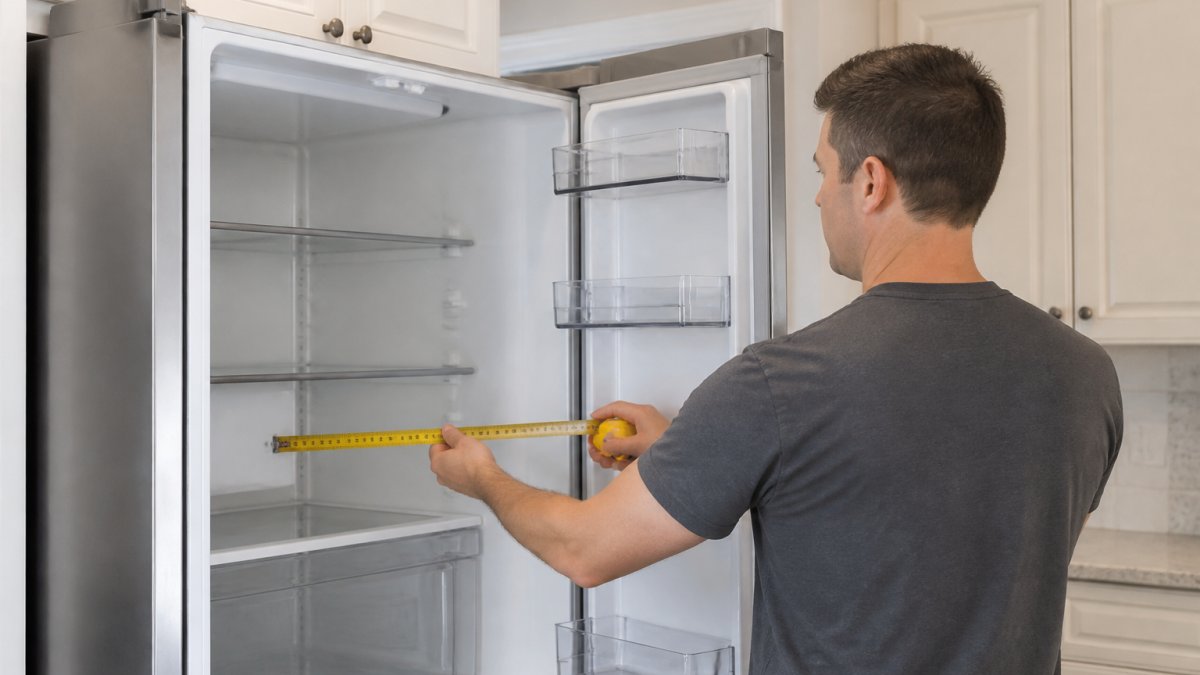
Open the door fully and measure interior width from left wall to right wall at the widest point, usually just inside the door opening. Measure interior height from the compartment floor to the ceiling, and interior depth from the front edge of the interior liner (not the door) to the back wall. If the back wall is stepped or has a compressor hump, measure to the deepest flat surface and note the obstruction.
Step 2: Multiply Width × Height × Depth for Each Compartment
Multiply the three measurements for each compartment separately. A main compartment measuring 28 inches wide, 60 inches tall, and 26 inches deep yields 28 × 60 × 26 = 43,680 cubic inches. A separate top freezer measuring 28 × 18 × 26 inches yields 13,104 cubic inches. Keep each compartment's total separate until conversion so you can report refrigerator and freezer capacity independently.
Step 3: Convert Cubic Inches to Cubic Feet
One cubic foot equals 12 inches × 12 inches × 12 inches, or 1,728 cubic inches. Divide each compartment's cubic-inch total by 1,728.
Main refrigerator: 43,680 ÷ 1,728 = 25.3 cubic feet Freezer: 13,104 ÷ 1,728 = 7.6 cubic feet Total capacity: 25.3 + 7.6 = 32.9 cubic feet
Round to one decimal place. If you measured in centimeters, convert to inches first (divide by 2.54) or convert cubic centimeters to cubic feet by dividing by 28,316.8.
Worked Example With Centimeters
Suppose a compartment measures 71 cm wide, 152 cm tall, and 66 cm deep. Then 71 × 152 × 66 = 712,272 cubic centimeters, and 712,272 ÷ 28,316.8 = 25.2 cubic feet. Alternatively, convert each dimension to inches first (28.0 × 59.8 × 26.0 = 43,534 cubic inches), then divide by 1,728 for the same 25.2 cubic feet.
Handling Irregular Interiors, Shelves, and Bins
Most interiors are not perfect rectangles, shelves, door bins, crisper drawers, and rounded corners reduce usable volume. Divide the interior into rectangular sections and calculate each separately. If a bottom freezer drawer occupies the lower 12 inches, measure the space above it and the drawer cavity as two sections and add them. If the ceiling slopes, average the tallest and shortest heights for that section.
Why Your Total May Differ From the Manufacturer Rating
Manufacturer-rated capacity is measured under standardized conditions and may include or exclude certain features by brand. Your DIY measurement reflects the layout you use daily, so a one- to two-cubic-foot difference is normal.
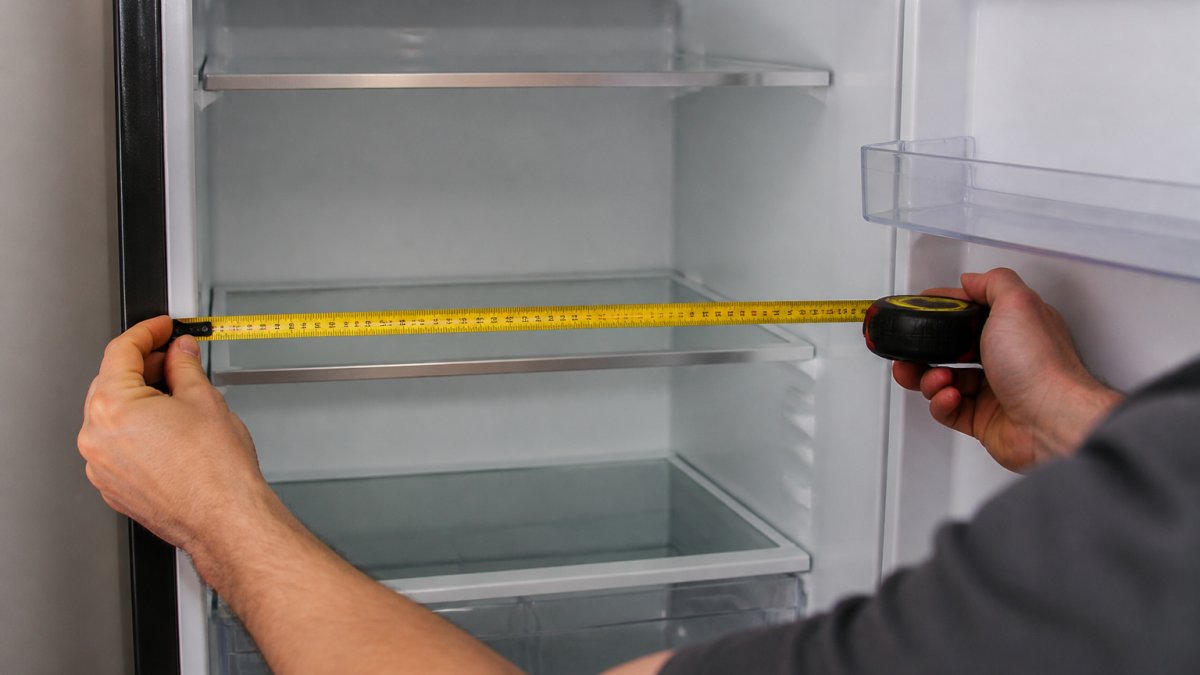
Measuring Refrigerator Interior Dimensions Accurately
Accuracy comes down to three habits: measure the interior liner (not the frame), keep the tape perpendicular to each surface, and record the smallest dimension in any irregular space. Small errors multiply across three numbers, a half-inch width mistake can shift a large refrigerator's result by nearly half a cubic foot.
Measure the Interior Liner, Not the Exterior Cabinet
The single most common error is measuring the outside of the refrigerator. Exterior dimensions include insulation, the cabinet frame, and door thickness, typically 2 to 4 inches on each side.
When measuring depth, start at the front edge of the interior liner, not the front of the door and not the door gasket. The door and its bins swing into the kitchen, not into the storage volume.
Keep the Tape Perpendicular and Consistent
Hold the tape perpendicular to the wall, an angled tape reads longer than the true dimension. For width, measure at the same height each time, typically midway up, and check points near the bottom and top; use the smallest reading. Measure in inches throughout if your tape has both scales, since mixing units is a frequent error.
Account for Shelves, Drawers, and Rounded Corners
Shelves and drawers reduce open volume. For a practical estimate, measure with shelves in their normal positions and treat each open rectangular section between shelves as its own box, then add the volumes. For rounded corners and sloped ceilings, don't calculate the curve, measure the straight sections and use the smallest width and depth you find, which already captures the slight loss.
Verify Your Measurement Against the Manufacturer Rating
After calculating your DIY capacity, compare it to the manufacturer's published rating, found on the interior label (usually a white or silver sticker near the top or side wall), in the owner's manual, or by searching the model number online. A one- to two-cubic-foot difference is normal. If your result is more than two cubic feet lower, recheck that you measured interior dimensions and used the smallest measurements for irregular spaces.
Common Mistakes That Skew the Result
- Measuring exterior dimensions: Inflates capacity by 10 to 20 percent or more. Always measure inside the liner.
- Including the door or door bins in depth: Adds several inches that are not part of the main compartment volume.
- Using 1,000 instead of 1,728 as the divisor: Inflates the cubic-foot result by roughly 73 percent.
- Mixing units: Multiplying inches by centimeters produces a meaningless number. Convert everything to one unit first.
- Measuring only one point in an irregular space: A single reading at the widest point overstates usable volume. Use the smallest of several readings.
- Forgetting to measure the freezer separately: If you want total capacity, measure each compartment independently and add the results.
How to Find Refrigerator Cubic Feet Without a Model Number
If you can't find your refrigerator's model number or specifications, calculate capacity using your measurements. Older models especially may lack clear labeling, making the DIY approach the most reliable method.
Checking the Product Label and Owner's Manual
Look for a white or silver label inside the refrigerator, usually near the top or on the side wall; it contains the model number and sometimes capacity. Search online for "[Model Number] cubic feet" or "[Model Number] specifications", most manufacturers post specs on their websites. The owner's manual lists capacity in its specifications section, and many manufacturers post manuals online as PDFs.
Verifying Manufacturer Capacity vs. Your Measurements
Manufacturer-rated and measured capacity may differ slightly, which is normal. Manufacturers measure under specific conditions, often with shelves removed or in a particular configuration, while your measurements reflect daily use; a one- to two-cubic-foot difference is acceptable. If your measurement is significantly smaller, check your math and confirm you measured interior dimensions. If larger, you likely measured exterior dimensions, redo it from interior wall to interior wall.
Common Mistakes to Avoid When Measuring
Several errors happen frequently:
- Measuring exterior dimensions: The most common mistake. Insulation and frame take up 2-4 inches per side, always measure inside.
- Including door thickness: Don't count the space the open door occupies; measure actual interior width.
- Measuring at different heights or angles: Measure width at the same height each time and keep the tape perpendicular. Angled readings inflate results.
- Ignoring rounded corners: Straight-line measurements won't capture curves perfectly; a slightly high calculation is normal.
- Using the wrong conversion factor: Divide cubic inches by 1,728, not 1,000, which inflates results significantly.
- Not measuring the freezer separately: Measure a distinct freezer compartment on its own unless you want total capacity.
Using Your Capacity Measurement to Choose the Right Refrigerator
Household size is the primary factor: a single person or couple typically needs 15-18 cubic feet, a family of four 20-25 cubic feet, and larger families or frequent cooks 25-30 cubic feet or more.
Fast Appliances LLC offers a wide variety of refrigerators, so you can find the exact size your household needs and budget allows. Look beyond cubic feet too: consider layout and shelf configuration, since some models offer flexible shelving and others dedicated compartments.
Frequently Asked Questions
How do I measure refrigerator capacity in cubic feet if I don't have the model number?
Measure the interior width, height, and depth in inches using a tape measure. Multiply all three numbers together, then divide by 1,728 to convert cubic inches to cubic feet. For example, a refrigerator measuring 30 inches wide, 66 inches tall, and 28 inches deep equals 55,440 cubic inches, or about 32 cubic feet. Check the owner's manual or product label if available to verify your calculation against the manufacturer's stated capacity.
What's the difference between interior and exterior refrigerator dimensions?
Interior dimensions measure the usable storage space inside the refrigerator, which determines actual capacity in cubic feet. Exterior dimensions include the cabinet walls and are larger. Always measure inside dimensions for capacity calculations. Exterior dimensions are used to ensure the refrigerator fits your kitchen opening and allows proper clearance for doors and ventilation. Capacity ratings are always based on interior volume, not the outside measurements.
How do I convert cubic inches to cubic feet?
Divide the total cubic inches by 1,728. For example, if your refrigerator interior measures 55,440 cubic inches, divide 55,440 by 1,728 to get 32.08 cubic feet. This conversion works because 1 cubic foot equals 12 inches × 12 inches × 12 inches, or 1,728 cubic inches. Keep a calculator handy to avoid errors, especially when measuring larger refrigerators or calculating separate compartments.
Should I include shelves and drawers when measuring refrigerator capacity?
Measure the interior space as if shelves and drawers were removed to get the total usable volume. Shelves, drawers, and door bins reduce the actual storage space available, but manufacturer capacity ratings typically account for these features. When measuring your own dimensions, focus on the interior cavity itself. If you want to know how much space is truly available for storage, subtract the volume taken up by permanent fixtures, but the standard capacity measurement uses the full interior dimensions.
Choosing the right refrigerator means understanding what capacity actually means for your household. Measuring cubic feet gives you a concrete number to compare models and ensure your new appliance fits your needs. When you're ready to replace or upgrade, Fast Appliances LLC offers a comprehensive selection of refrigerators in every size range. Our team can help you find the perfect fit for your kitchen and lifestyle.