 ultimate-guide
How to Choose Energy Efficient Appliances
Table of Contents
- Why Energy Efficient Appliances Matter for Your Utility Bills
- EnergyGuide Label Explained: How to Read It Before You Buy
- Energy Star Certification Requirements: What the Label Actually Means
- Federal Tax Credits for Energy Efficient Appliances in 2026
- Sizing, Load Capacity, and Matching Appliances to Your Home
- Smart Home Integration and Behavioral Efficiency
- Repairability vs. Replacement: Appliance Lifecycle and Carbon Footprint
- Choosing Energy Efficient Appliances by Type: A Practical Comparison
- Frequently Asked Questions
Last Updated: August 14, 2026
Why Energy Efficient Appliances Matter for Your Utility Bills
Household appliances account for a significant share of monthly energy costs. Choosing efficient models is one of the most direct ways homeowners can reduce utility bills without changing their lifestyle.
Energy efficient appliances deliver the same performance as standard models while consuming fewer kilowatt-hours per cycle or per year. Over a ten-year lifespan, the efficiency gap between the least and most efficient models translates into real savings on utility bills.
A refrigerator running 24 hours daily contributes far more to power consumption than an oven used for an hour. Prioritizing efficiency on always-on appliances like refrigerators and water heaters delivers the highest return on investment. Reducing energy consumption also lowers your household's carbon footprint and reduces the load on the electrical grid during peak demand periods.
EnergyGuide Label Explained: How to Read It Before You Buy
The EnergyGuide label is a yellow tag required by the Federal Trade Commission on most major appliances sold in the United States. It provides a standardized way to compare energy performance before you buy. According to the Federal Trade Commission's EnergyGuide program overview, the label is mandatory on refrigerators, freezers, water heaters, dishwashers, washing machines, room air conditioners, and several other product categories.
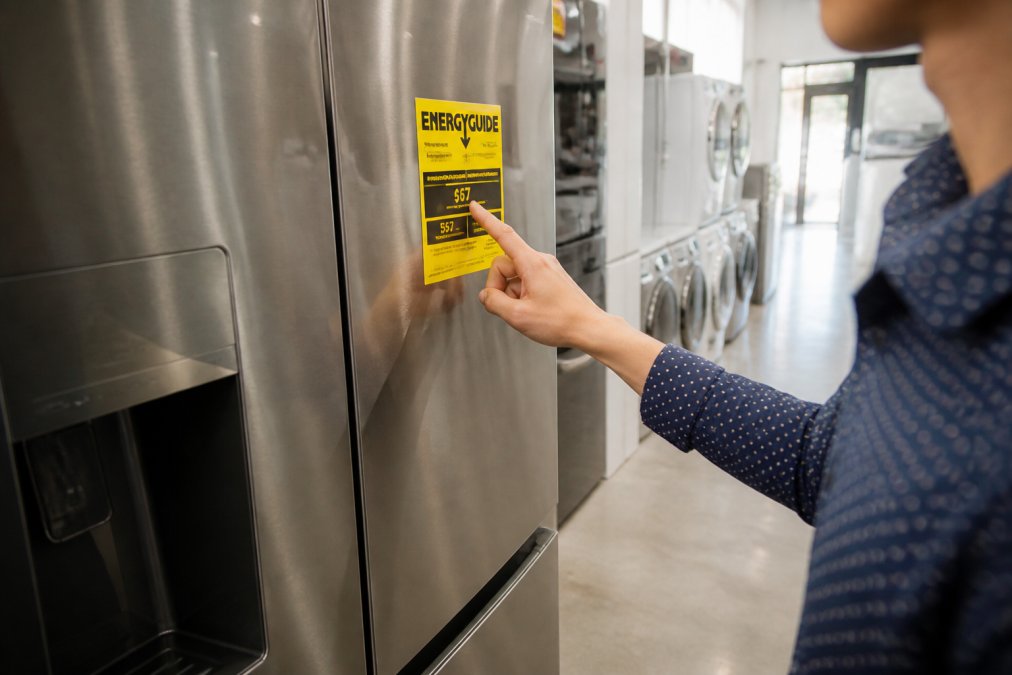
What Each Section of the Label Tells You
The label identifies the appliance type and model at the top. The center section shows estimated annual energy consumption in kilowatt-hours, the single most useful number for comparing models. The bottom section displays estimated annual operating cost based on national average electricity rates.
The scale bar shows where this model falls compared to similar models. A model near the left uses significantly less energy than models near the right. This visual comparison works well when evaluating multiple units side by side.
Comparing Annual Operating Cost Across Models
The annual operating cost on the EnergyGuide label is an estimate based on standardized usage and national average rates. Your actual cost varies based on local utility rates, usage frequency, and settings.
Use the kilowatt-hour figure rather than the dollar estimate when comparing models. Multiply the annual kilowatt-hour figure by your actual electricity rate per kilowatt-hour to get a cost estimate reflecting your real situation.
Energy Star Certification Requirements: What the Label Actually Means
Energy Star certification is a government-backed program administered by the U.S. Environmental Protection Agency. An appliance earns the Energy Star label by meeting energy performance thresholds stricter than federal minimum standards. The program covers many product categories and is one of the most reliable efficiency certifications available.
The core value of Energy Star is trust. The EPA sets thresholds, manufacturers submit test data, and independent labs verify results. It's not a marketing label; it's a certification requiring measurable standards.
Energy Star Thresholds by Appliance Type
Thresholds vary by product category because the relevant efficiency metric differs across appliance types. The Energy Star product certification requirements by category are published publicly and updated as technology improves.
| Appliance Type | Key Efficiency Metric | Energy Star Requirement |
|---|---|---|
| Refrigerators | Annual kilowatt-hours | At least 15% more efficient than federal minimum |
| Dishwashers | Energy factor / water use | Stricter water and energy use limits |
| Washing Machines | Integrated Energy Factor | Significantly higher than federal standard |
| Dryers | Combined Energy Factor | Must meet CEF threshold set by EPA |
| Room Air Conditioners | Energy Efficiency Ratio | Higher EER than minimum federal requirement |
| Ovens/Ranges | Convection and standby power | Standby power limits and cooking efficiency |
A higher Energy Star requirement doesn't always mean higher upfront cost. Many certified models are priced competitively with non-certified alternatives.
Federal Tax Credits for Energy Efficient Appliances in 2026
The tax credit landscape for home appliances has shifted in recent years. Under the Inflation Reduction Act, certain home energy improvements qualify for federal tax credits. The credits available in 2026 focus primarily on heat pump water heaters, heat pump clothes dryers, and biomass stoves rather than conventional refrigerators or standard electric ranges. According to the IRS guidance on energy efficient home improvement credits, the Energy Efficient Home Improvement Credit covers qualifying appliances up to specified annual limits.
Heat pump water heaters are one of the most significant qualifying categories. They use heat pump technology to move heat rather than generate it, dramatically reducing energy consumption compared to conventional resistance water heaters.
To claim the credit, file IRS Form 5695 with your federal tax return for the year of purchase and installation. Keep your purchase receipt and any manufacturer certification statements. The manufacturer certifies that a product qualifies; you don't need to verify technical specifications yourself.
A common mistake is assuming all Energy Star appliances qualify for tax credits. They don't. The credit applies to a specific list of product types meeting defined performance thresholds. Check current IRS guidance before you buy.
Sizing, Load Capacity, and Matching Appliances to Your Home
Bigger is not more efficient. An oversized refrigerator runs more frequently to maintain temperature in a larger interior than you use. An oversized washing machine uses more water per cycle even on small loads. Appliance efficiency ratings are measured under standardized conditions; real-world performance depends on how well the appliance matches your actual usage.
For refrigerators, measure your kitchen space and choose capacity matching your household size. For washing machines, load capacity should match your typical laundry volume. Running a large-capacity washer at half load repeatedly is less efficient than running a properly sized machine at full capacity.
Sizing also affects appliance lifespan. A unit running within its designed load range experiences less wear than one consistently under or over capacity. Matching load capacity to actual use extends appliance lifespan and maintains operational efficiency over time.
Smart Home Integration and Behavioral Efficiency
Smart appliances represent a real shift in how households manage energy consumption.
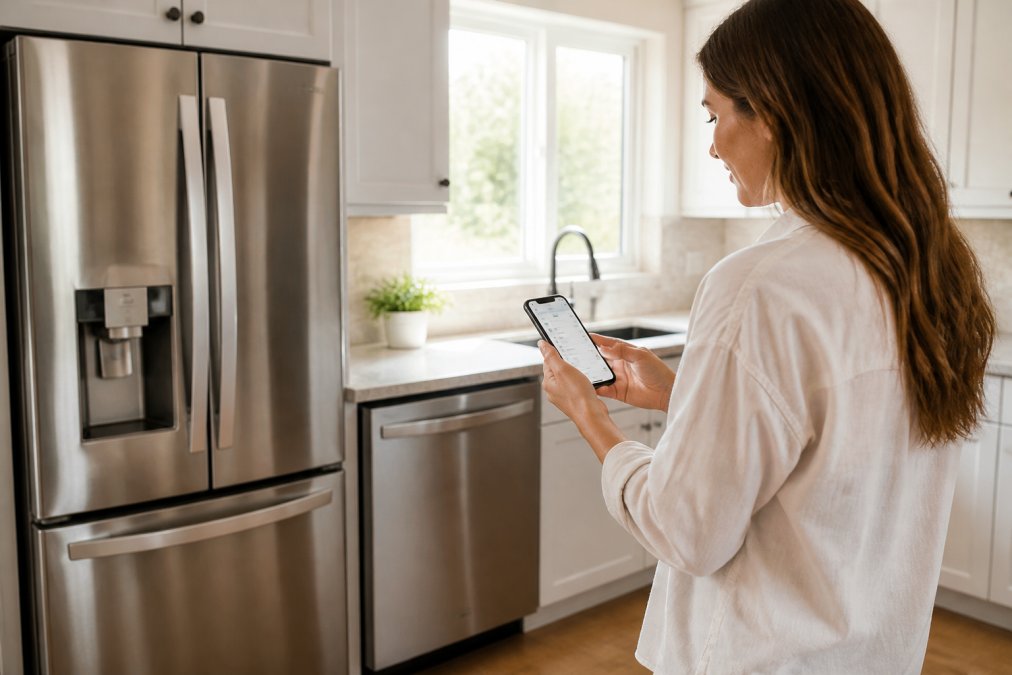
Smart features allow appliances to communicate with your home's energy management system, shift operation to off-peak hours, and provide real-time power consumption data. A smart washing machine can delay its cycle to run during overnight hours when electricity rates are lower on time-of-use utility plans. A smart dishwasher can notify you when a cycle finishes rather than running a heated dry cycle unnecessarily.
Behavioral efficiency is the concept that how you use an appliance matters as much as its energy rating. Running a dishwasher only when full, using cold water wash cycles, cleaning refrigerator coils annually, and avoiding standby power waste all reduce annual energy consumption. The combination of smart features and conscious behavior produces better results than either alone.
Repairability vs. Replacement: Appliance Lifecycle and Carbon Footprint
Manufacturing a new appliance requires raw materials, energy, and transportation. That embedded carbon cost exists whether the appliance is efficient or not. Replacing a functioning appliance with a more efficient model only makes environmental sense if operating efficiency gains over the remaining useful life outweigh the manufacturing footprint of the new unit.
Repairability is a practical factor rarely appearing on specification sheets. Some brands design products with accessible components and widely available parts. Others use proprietary parts making repair expensive or impossible. Before buying, check whether replacement parts are available and whether independent repair technicians can service the model. The Right to Repair advocacy resources and appliance repairability data tracks manufacturer repairability practices.
A longer appliance lifespan means more time to recover the upfront cost of an efficient model. An appliance lasting 15 years instead of 10 provides five additional years of energy savings. Maintenance determines how long that lifespan extends.
Choosing Energy Efficient Appliances by Type: A Practical Comparison
Efficiency considerations differ meaningfully across appliance categories.
Refrigerators and Freezers
Refrigerators are the highest-priority appliance for energy efficiency because they run continuously. The annual kilowatt-hour figure on the EnergyGuide label is the most important comparison point. French door and side-by-side configurations generally use more energy than top-freezer models. If you don't need additional capacity, a top-freezer model with Energy Star certification typically shows the lowest annual energy consumption.
Setting your freezer colder than necessary increases energy consumption without improving food safety. Most guidance recommends 0°F for freezers and 35-38°F for refrigerator compartments.
Washers, Dryers, and Dishwashers
Front-loading washing machines generally use less water and energy per cycle than top-loaders, though high-efficiency top-loaders have narrowed the gap. The Integrated Energy Factor is the key metric for washers. For dryers, look for moisture-sensor drying rather than timed cycles. Moisture sensors stop the cycle when clothes are actually dry, preventing over-drying and wasted energy.
Dishwashers with Energy Star certification use less water per cycle than hand-washing for equivalent loads. Choosing a model with a soil sensor, which adjusts cycle length based on how dirty the dishes are, reduces energy consumption in daily use.
Ovens, Cooktops, and Microwaves
Induction cooktops are the most energy-efficient cooking surface available. They transfer heat directly to cookware using electromagnetic energy rather than heating a burner first, reducing energy loss significantly. Convection ovens circulate hot air and cook food faster at lower temperatures than conventional ovens.
Microwaves use far less energy than ovens for reheating and cooking smaller portions. Using a microwave instead of a full oven for tasks not requiring dry heat is one of the simplest behavioral efficiency wins.
| Appliance | Most Efficient Type | Key Metric to Compare |
|---|---|---|
| Refrigerator | Top-freezer, Energy Star | Annual kWh on EnergyGuide |
| Washing Machine | Front-load or HE top-load | Integrated Energy Factor |
| Dryer | Heat pump dryer | Combined Energy Factor |
| Dishwasher | Energy Star with soil sensor | Annual kWh and water use |
| Cooktop | Induction | Energy transfer efficiency |
| Oven | Convection | Temperature and time settings |
Selecting energy efficient appliances across your whole home is a series of targeted choices. Prioritize always-on appliances, match sizing to actual use, and look beyond the Energy Star badge to the EnergyGuide numbers. Fast Appliances LLC carries a wide selection across all categories, making it straightforward to compare models and find the right fit for your home and budget.
Choosing energy efficient appliances is one of the most effective ways to reduce household utility bills and lower your home's carbon footprint over the long term. Fast Appliances LLC offers a comprehensive online selection of washers, dryers, refrigerators, dishwashers, ovens, cooktops, and microwaves, making it simple to find Energy Star-certified models with the EnergyGuide ratings that match your home's needs. Browse the full range at Fast Appliances LLC and get the right appliance delivered directly to your door.
Frequently Asked Questions
Are Energy Star appliances worth the extra cost?
For most households, yes. Energy Star certified appliances use measurably less power than standard models, which reduces kilowatt-hour consumption year over year. The annual operating cost savings vary by appliance type, but over a typical appliance lifespan of 10 to 15 years, the cumulative reduction in household utility bills often exceeds the upfront price difference. When you factor in available utility rebates and federal tax credits, the return on investment improves further.
How do I read the EnergyGuide label?
The yellow EnergyGuide label shows the appliance's estimated annual energy consumption in kilowatt-hours and its projected annual operating cost based on average electricity rates. A scale across the middle compares that model's energy use against similar models on the market. The lower the kilowatt-hour figure, the less the appliance costs to run. Look for the estimated yearly cost prominently displayed, that single number makes it easy to compare two models side by side before you buy.
What appliances qualify for energy tax credits?
Under the Inflation Reduction Act, certain home appliances qualify for federal tax credits when they meet specific efficiency thresholds. Heat pump clothes dryers and heat pump water heaters are among the qualifying categories, with credits available through the IRS Form 5695. Eligibility depends on the appliance meeting current Energy Star certification requirements and the credit limits set by the IRS for that tax year. Always verify current thresholds on IRS.gov or with a tax professional before purchasing.
What appliance uses the most electricity and drives up your bill?
Heating and cooling systems account for the largest share of most households' energy consumption, but among appliances specifically, electric water heaters, refrigerators running continuously, and older electric dryers tend to be the biggest contributors to high utility bills. An older refrigerator without modern thermal regulation can use two to three times the energy of a current Energy Star model. Running a dryer on full heat for large loads daily adds up quickly in kilowatt-hours.
What appliances should be unplugged to save electricity?
Appliances in standby power mode draw electricity even when not in use. Microwaves, coffee makers, and older televisions are common standby power offenders. Unplugging them when not in use, or plugging them into a smart power strip, can reduce phantom load. That said, the savings from standby reduction are modest compared to upgrading an inefficient refrigerator or washer, so prioritize replacing high-consumption appliances first if your goal is meaningful energy savings.
Should I repair my old appliance or replace it with an energy efficient model?
A useful rule of thumb: if a repair costs more than 50% of the appliance's replacement value and the unit is over halfway through its expected lifespan, replacement typically makes more financial sense. A new Energy Star model will also lower your annual operating cost going forward. Factor in the appliance's lifecycle carbon footprint too, manufacturing a new unit has an environmental cost, so a minor repair that extends a working appliance's life by several years can be the more sustainable choice.
This article was written using GrandRanker