 ultimate-guide
What to Look for in Durable Appliances: 2026 Guide
Table of Contents
- What to Look for in Durable Appliances: The 8-Point Checklist
- Build Quality: Materials and Construction That Last
- Functionality and Features: Matching the Appliance to How You Cook and Clean
- Appliance Size and Available Space: Measure Before You Buy
- How Long Do Appliances Last? Expected Lifespan by Type
- Most Reliable Appliance Brands and How to Read Appliance Reliability Ratings
- Appliance Warranty Coverage: What's Included and What's Excluded
- Repairability and Total Cost of Ownership
- Frequently Asked Questions
Last Updated: October 12, 2026
What to Look for in Durable Appliances: The 8-Point Checklist
Durable appliances are built from quality materials, use repairable components, and carry warranties that match their expected lifespan. When shopping, check eight things: build materials, hinge and glide quality, control panel design, fit for your space, expected lifespan, brand reliability history, warranty terms, and parts availability.
Most buyers focus on price and finish. The smarter move is to inspect what you cannot see: the steel gauge, the hinge mechanism, the board behind the touch panel.
Below, we break down each factor, plus the gap most buying guides skip entirely: what happens after year three, when the warranty ends and the repair bills start.
Build Quality: Materials and Construction That Last
Build quality is the single strongest predictor of how long an appliance survives daily use. Materials and construction decide durability more than brand name or price tag.
Stainless Steel, Coated Steel, and Plastic: What Holds Up
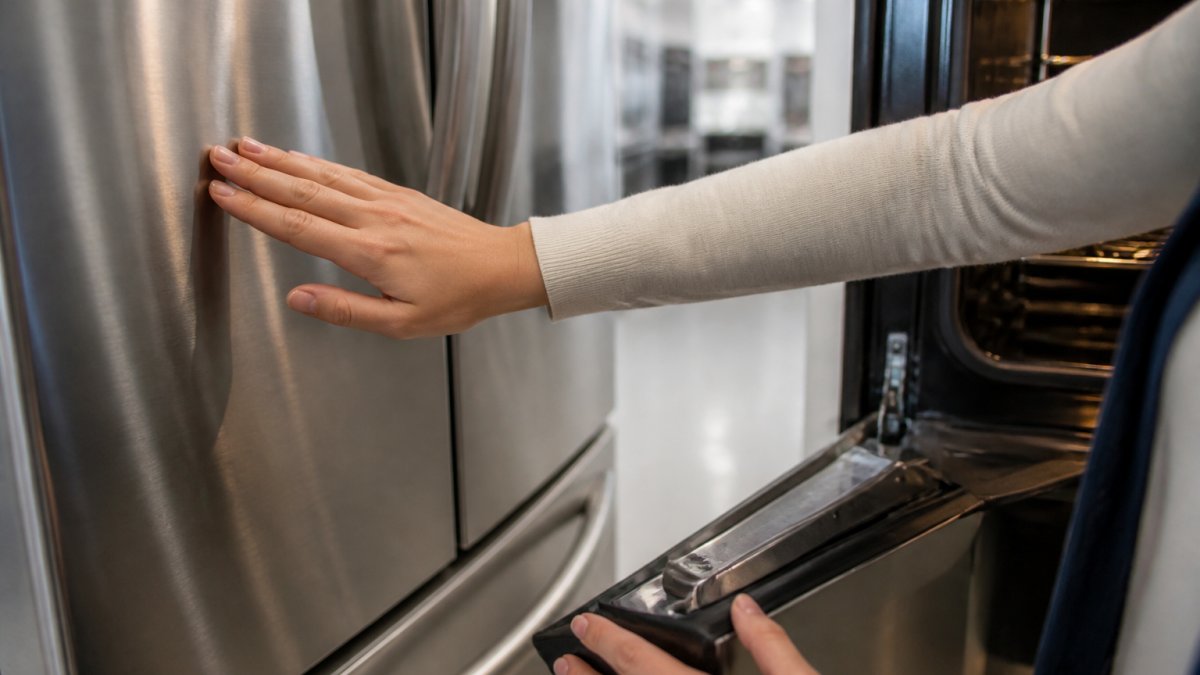
Real stainless steel resists rust and dents far better than coated steel, which chips and corrodes once scratched. Plastic is fine for trim and bins, but never for structural parts like door frames or drum supports.
We recommend checking the finish with a magnet. Quality stainless steel grips weakly or not at all; coated steel grabs firmly. It takes ten seconds and tells you more than any spec sheet.
Door Hinges, Drawer Glides, and Control Panels
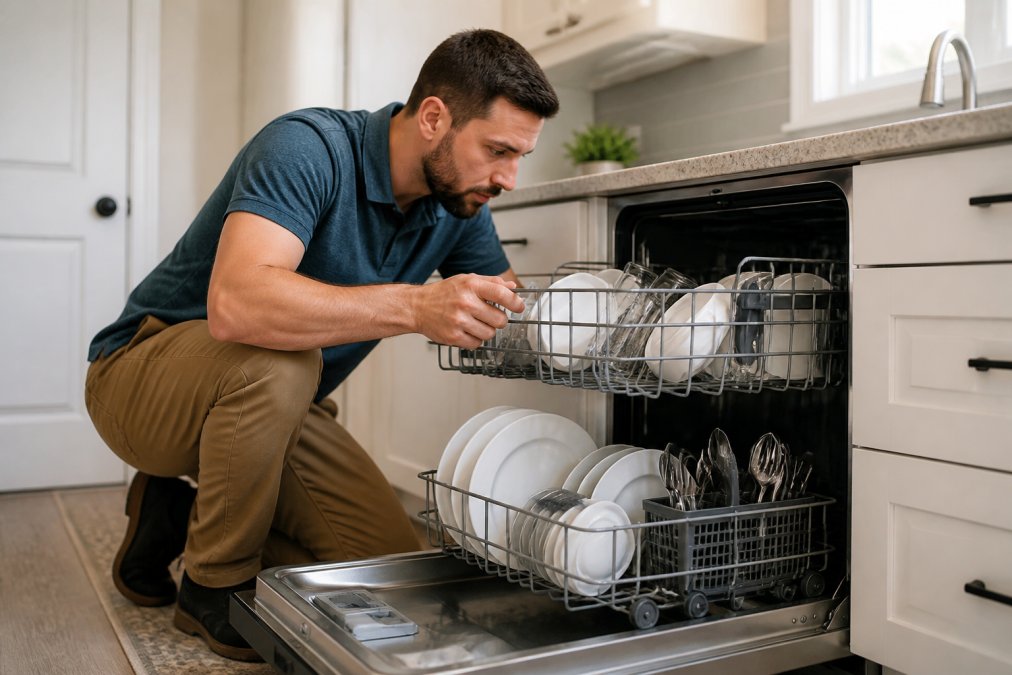
Open and close every door and drawer on the floor model, or ask about the mechanism if you are ordering online. Metal hinges outlast plastic ones, and ball-bearing glides beat friction slides for dishwasher racks and oven drawers. Control panels with physical knobs usually survive longer than all-touch interfaces, because a failed board can take the whole panel with it.
Functionality and Features: Matching the Appliance to How You Cook and Clean
Functionality means the appliance fits how your household actually cooks and cleans, not how a showroom display suggests you might. The right feature set prevents the wear that comes from workarounds.
Refrigerators, Dishwashers, Ranges, and Ovens
A refrigerator with adjustable shelving and a well-sealed door gasket holds temperature better and works less hard. In a dishwasher, stainless steel tubs resist staining and odor compared with plastic tubs. For ranges and ovens, convection fans and self-cleaning cycles add convenience, but each extra mechanism is another part that can fail.
Think about your real routine before you commit to features you will rarely use.
Smart Features and Electronic Controls: Convenience vs. Failure Points
Smart features add convenience, but every sensor, Wi-Fi module, and touch board is a potential failure point. Temperature alerts and remote diagnostics are genuinely useful. A touchscreen that controls nothing but the clock is not worth the risk.
Appliance Size and Available Space: Measure Before You Buy
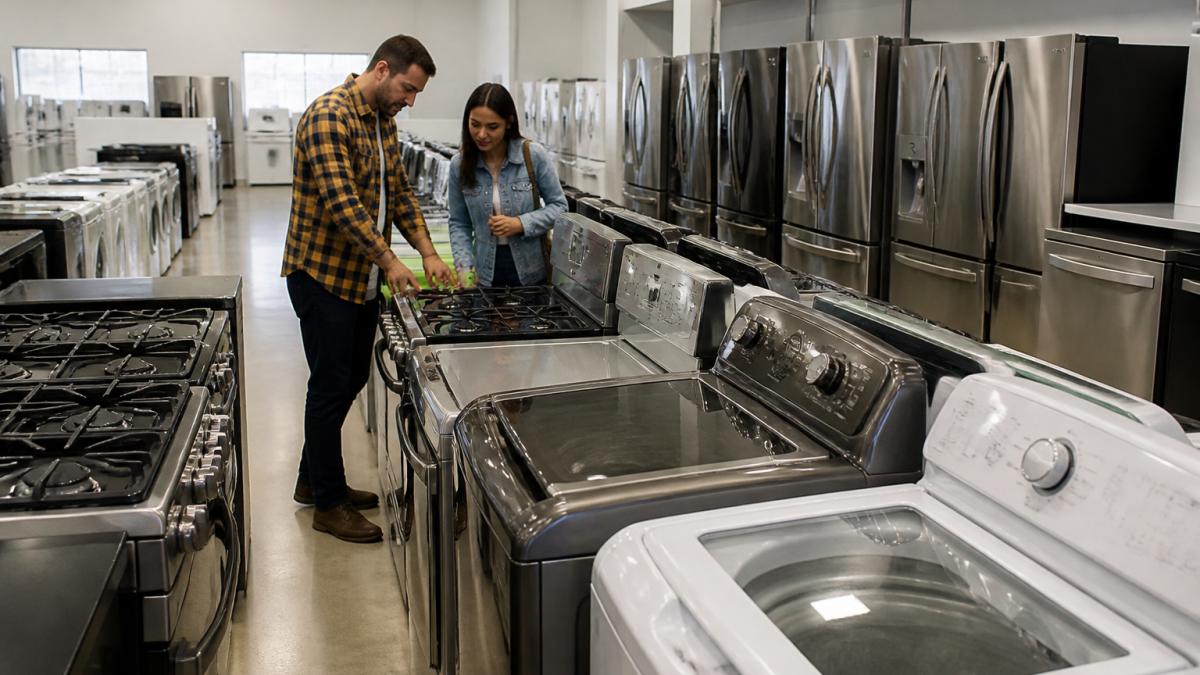
Measure your space before you buy, and measure the doorway too.
Grab a tape measure and record width, height, and depth for the opening, plus clearance for doors to swing open and for ventilation behind the unit.
Buying online makes this step more important, not less. A ten-minute measurement session prevents a return, a restocking fee, and a week without a working refrigerator.
How Long Do Appliances Last? Expected Lifespan by Type
Lifespan ranges are useful only when you know what moves a unit from the bottom of the range to the top. The table below reflects typical service life under normal household use, but the wear factors column is where the real decision-making happens.
| Appliance | Typical Lifespan | Main Wear Factor | What to Inspect Before Buying |
|---|---|---|---|
| Refrigerator | 10-18 years | Compressor and door seals | Door gasket thickness and seal, condenser coil access, compressor brand |
| Dishwasher | 8-12 years | Pump and tub material | Stainless tub vs. plastic, pump accessibility, rack glide type |
| Range or oven | 12-18 years | Heating elements and controls | Element mounting, knob vs. touch controls, door hinge tension |
| Washer | 8-14 years | Drum bearings and seals | Drum support type, door boot material, lid or door latch |
| Dryer | 10-15 years | Belt, motor, and venting | Belt access panel, lint trap design, vent path |
| Microwave | 7-10 years | Magnetron and door latch | Door latch feel, magnetron warranty length |
Treat these as planning ranges, not guarantees. A well-maintained unit at the top of its range beats a neglected one every time.
What Actually Shortens Appliance Life
Most premature failures trace back to a handful of preventable conditions:
- Heat buildup. Refrigerators with blocked condenser coils run hotter and cycle more. Vacuuming coils every six to twelve months is one of the cheapest lifespan extenders available.
- Moisture intrusion. Washer door boots and dishwasher door gaskets that stay wet grow mold and lose their seal. Wiping them dry after use and leaving doors ajar between cycles slows that decay.
- Vent restriction. Dryers with lint-clogged or crushed vent ducts overheat the motor and belt. A rigid metal duct with a short, straight run outperforms flexible foil every time.
Maintenance That Extends Lifespan
A simple annual routine covers most of what matters: clean refrigerator coils and door gaskets, run a dishwasher cleaning cycle with a descaler, inspect washer hoses for bulging or cracking, clear the dryer vent from the back of the unit to the exterior, and check oven door hinges for sag. Replacing a worn door gasket or a cracked washer hose costs far less than the failure it prevents.
Most Reliable Appliance Brands and How to Read Appliance Reliability Ratings
Brand reliability ratings are useful only when you know what they measure. Most ratings reflect repair rates within the first few years of ownership, not decade-long performance, so read the methodology before you trust the score.
Verifying Reliability Claims Before You Buy
A high rating means fewer early failures, not a longer life. Look for ratings that disclose sample size, model coverage, and time period. A brand with a strong score on one model line may score poorly on another.
We suggest a simple verification routine:
- Check whether the rating names specific models, not just the brand
- Look for owner reviews that mention failures after year two
- Search the model number plus "repair" to see real-world patterns
- Confirm the brand still stocks parts for that model
Appliance Warranty Coverage: What's Included and What's Excluded
Appliance warranty coverage typically protects parts and labor for a limited period, and it almost never covers everything you assume.
Exclusions matter more than the headline term. Most warranties exclude cosmetic damage, improper installation, power surges, and normal wear items like belts and filters.
Keep your receipt and registration confirmation. Without proof of purchase, a warranty claim can stall even when the failure is clearly covered.
Repairability and Total Cost of Ownership
Repairability determines what you actually pay over the life of an appliance, not just at checkout. A cheaper unit with hard-to-find parts can cost more than a pricier model that is easy to fix. This is the section most buying guides skip, and it is where durable-appliance decisions are won or lost.
How to Check Parts Availability Before You Buy
Before committing to a model, verify that replacement parts exist and are reasonably priced:
- Look up the model number on the manufacturer's parts site and confirm that common wear items, such as door gaskets, drain pumps, heating elements, and control boards, are listed and in stock.
- Check whether the brand publishes a parts diagram or service manual for that model. Brands that do make independent repair far easier.
- Search the model number plus "repair" and read owner threads about which components fail and how long parts take to arrive.
- Confirm that at least one local technician services the brand. A repairable appliance with no one to repair it is not repairable in practice.
Design Features That Lower Repair Costs
Modular construction is the single biggest factor in repair cost. A dishwasher with a pump that unclips from the sump without pulling the whole tub, a refrigerator with a front-accessible evaporator fan, or a range with plug-in surface elements all reduce labor hours. Labor, not parts, is usually the larger line item on a repair invoice. Ask whether the design allows common repairs from the front of the unit or requires pulling it out from the wall.
Warranty Coverage vs. Out-of-Pocket Repair
Standard coverage usually runs one year for parts and labor, with longer terms for specific components like the compressor or sealed system. The math that matters is what happens after that first year:
- A sealed-system failure on a refrigerator is typically the most expensive common repair, which is why compressor warranties often extend well past the general term.
- Control board failures are common across categories and usually fall outside extended component coverage.
- Normal wear items such as belts, filters, and gaskets are almost never covered, so budget for them as routine maintenance.
Keep your receipt and registration confirmation. Without proof of purchase, a warranty claim can stall even when the failure is clearly covered. Read the exclusions before you buy, not after a failure.
Energy Use and the Rest of Ownership Cost
Total cost of ownership adds energy use and maintenance to the purchase price. Energy Star labeled models use less power, and over years that difference adds up, particularly for refrigerators and dryers that run frequently. Factor in filter replacements, descaling, vent cleaning, and any extended warranty you choose. A unit that is cheap to buy but expensive to run and repair is not a bargain.
Frequently Asked Questions
What features make an appliance durable?
Durability comes down to a few concrete things: heavy-gauge stainless steel or coated steel panels instead of thin plastic, metal door hinges and drawer glides rather than plastic ones, sealed or protected electronic control boards, and a compressor or motor rated for continuous use. Adjustable shelving and temperature alerts are nice, but they do not extend lifespan. Focus on materials, moving parts, and how the appliance is sealed against moisture and heat, since those are what fail first in kitchens and laundry rooms.
How can you tell if an appliance is reliable before buying it?
Start with the spec sheet and the warranty. A longer parts-and-labor warranty signals the manufacturer expects the appliance to last. Look at appliance reliability ratings from published owner surveys, then read the one-star and two-star reviews specifically, because they describe repeated failure points. Check whether replacement parts are sold separately and whether local technicians service the brand. If a model has been on the market for two or more years with steady ratings, that track record is more useful than a launch-week review.
Which appliance brands are the most dependable?
There is no single winner across every category. Brands that score well on appliance reliability ratings for refrigerators often rank differently for dishwashers or ranges. Instead of chasing one name, compare within the category you are buying. Look at repair rates, average appliance lifespan, and how easy it is to get replacement parts. A mid-priced model from a brand with strong service coverage usually beats a premium model from a brand you cannot get repaired locally.
How long should major home appliances last?
Typical ranges are 10 to 15 years for refrigerators, 9 to 12 years for dishwashers, 13 to 15 years for ranges and ovens, and 10 to 13 years for washers and dryers. Actual life depends on how hard the appliance works, whether it gets routine maintenance, and whether the home has stable voltage and proper ventilation. An appliance that fails well before these ranges usually points to a repairable issue like a clogged drain, a worn door gasket, or a failed control board.
Does an extended warranty make sense for major appliances?
It depends on the appliance and the terms of the appliance warranty coverage. Refrigerators and washers, which contain compressors and motors, are the most common candidates because repairs are expensive. Before buying an extended plan, read the exclusions: many exclude cosmetic damage, improper installation, and pre-existing issues. Compare the plan's total cost against the price of a typical repair for that appliance. If the plan costs close to a repair and covers parts and labor, it can be worth it.
Is it worth paying more for a durable appliance?
Often yes, but only when the extra cost goes into parts that fail. A higher purchase price buys longer life when it means a better compressor, a stainless steel interior, or a longer warranty. It is not worth paying more for cosmetic trim or app features that do not affect how the appliance runs. Add up purchase price, expected repairs, and operating costs over the appliance's lifespan. A slightly more expensive model that lasts three extra years usually costs less per year of use.
What should you check before buying a used appliance?
Ask for the model number and manufacture date, then look up how long that model typically lasts. Run the appliance through a full cycle if possible, and check for rust, water stains, or a burning smell. Test every control, listen for unusual noise from the compressor or motor, and inspect door seals for cracks. Confirm whether the original warranty transfers to a second owner, since many do not. Used appliances can be a good value, but only when parts are still available.
Choosing appliances that last comes down to inspecting what most shoppers ignore: materials, repairability, and warranty terms. At Fast Appliances LLC, we stock a wide variety of washers, dryers, refrigerators, stoves, microwaves, dishwashers, cooktops, and ovens, and our team helps you match the right unit to your space and your budget. Order online and we deliver essential appliances right to your door. Get started with Fast Appliances LLC and furnish your home with equipment built to last.