 blog
Does a Smart Oven Really Use Less Energy Than a Convection Oven?
Last Updated: November 11, 2026
Quick Summary
A smart oven is not automatically more energy efficient than a convection oven, because the two terms describe different things: how an oven is controlled versus how it circulates heat. Energy use depends mainly on wattage, chamber size, and how long the heating elements run. Smart features can trim cooking time, but connectivity alone does not make the heating elements more efficient.
- A convection oven circulates hot air with a fan, which typically shortens cooking times.
- Smart ovens add Wi-Fi, app control, or presets, and many also use convection.
- Standby draw from connectivity is small, typically a few watts, but runs all day.
- Probes and automatic cook modes can end cooking at target doneness and cut wasted run time.
- Use label wattage, your local rate, and your effective on-time to estimate cost per session.
Table of Contents
- Smart Oven vs Convection Oven: What the Terms Actually Mean
- How Much Electricity Does a Toaster Oven Use Per Hour?
- Wattage, Cooking Chamber Size, and Heat Loss Explained
- Preheating, Cooking Time, and Energy per Session
- Toaster Oven vs Conventional Oven Cooking Times
- Do Smart Features Change the Energy Bill?
- Estimating Your Own Electricity Cost at Your Local Rate
- Choosing an Energy Efficient Toaster Oven for Your Kitchen
- Frequently Asked Questions
Smart Oven vs Convection Oven: What the Terms Actually Mean
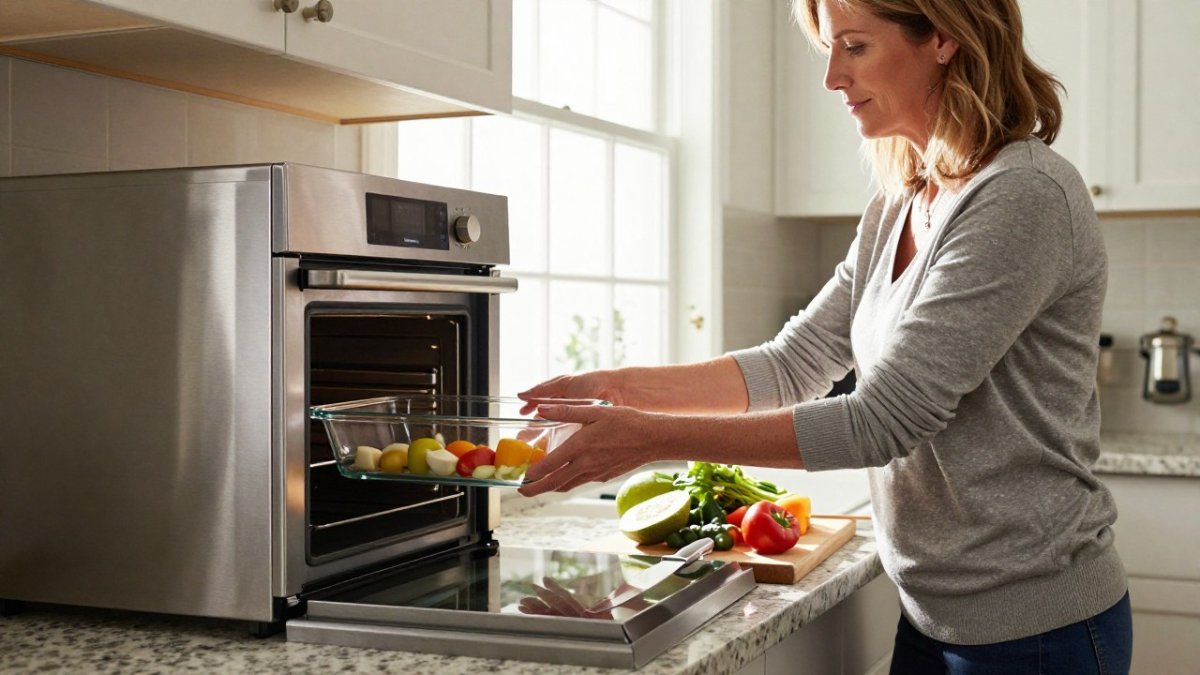
Shoppers often treat "smart oven" and "convection oven" as competing categories, but they describe different things. A convection oven is defined by how it cooks: a fan circulates hot air around the food, which typically shortens cooking times. A smart oven is defined by how it is controlled: Wi-Fi connectivity, app control, or built-in presets that adjust settings for you. Many smart ovens also use convection, so the two terms overlap rather than exclude each other.
That overlap is why the energy question is harder than it first looks. Comparing a smart oven to a convection oven only makes sense if you know which features each one actually has. Check the wattage rating and the convection specification on each product listing before comparing energy use.
How Much Electricity Does a Toaster Oven Use Per Hour?
A countertop toaster oven typically draws somewhere in the range of 1,000 to 1,800 watts when its heating elements are running. Power is the rate at which an appliance uses energy, so a 1,500-watt oven running for one hour uses 1.5 kilowatt-hours (kWh). The rated wattage on the label is the maximum draw, not the average, because the elements cycle on and off to hold a temperature.
Your actual cost depends on your electricity rate, which varies by utility and by region across the United States. Use the wattage on the product label as your starting point, then multiply by your local rate per kWh to estimate cost. Figures in the research for this topic are limited, so treat any single number as an estimate, not a measured result for a particular model.
Wattage, Cooking Chamber Size, and Heat Loss Explained
Wattage tells you how fast an oven can heat. Cooking chamber size tells you how much heated air must be maintained. A larger chamber generally holds more heat in absolute terms, and it loses more heat to the surrounding kitchen through its walls and door each time it opens.
Heat loss is where small ovens often have an advantage. A compact cooking chamber has less surface area and less air to heat, so for small meals it can reach temperature and hold it with less energy than a full-size oven. For a large roast, the picture reverses, because a full-size oven is simply the right tool for the job.
Watch out: a smaller oven is only efficient when its capacity matches your meal. Cooking a single slice of toast in a large oven wastes the energy needed to heat the empty space.
Preheating, Cooking Time, and Energy per Session
Preheating is one of the largest energy costs in any oven. Most toaster ovens reach temperature faster than full-size ovens because their chambers are smaller, which means less preheat time and less energy spent before food goes in. Skipping preheat entirely is practical for many toaster oven recipes, though results vary by food and recipe.
Total energy per cooking session is roughly the wattage multiplied by the time the elements are active. A session with a short preheat and a brief cook uses noticeably less energy than a long roast in a full-size oven. For a realistic estimate, time your typical cooking sessions and multiply by the wattage on your model's label.
The article's figures for a typical session break down into these steps and their energy effects.
| Factor | Effect on energy | Note |
|---|---|---|
| Preheating | One of the largest energy costs | Smaller chambers reach temperature faster |
| Skipping preheat | Reduces energy spent before cooking | Results vary by food and recipe |
| Wattage × time elements are active | Sets total energy per session | Estimate from your model's label |
| Short preheat and brief cook | Uses noticeably less energy | Compared with a long roast in a full-size oven |
Toaster Oven vs Conventional Oven Cooking Times
Cooking times differ because toaster ovens have smaller chambers and often shorter preheat cycles. Many recipes written for a conventional oven can be adapted, but the time and temperature usually need adjusting. Start checking food earlier than the recipe suggests, since small ovens can run hot at the top or edges.
Convection settings can shorten cooking time further by moving hot air around the food. Shorter cooks mean less total energy, which is one reason convection is often cited as more efficient. The actual saving depends on the dish, so check doneness rather than relying only on the clock.
Do Smart Features Change the Energy Bill?
Smart features affect the energy bill in two separate ways: a small always-on standby load, and a potentially larger effect on cooking time through sensors and automation. The two should be evaluated separately.
Standby and networked draw. A smart oven keeps a control board, display, and Wi-Fi or Bluetooth radio alive even when it is not cooking. The heating elements are off in that state, so the draw is small in absolute terms, typically a few watts rather than the 1,000 to 1,800 watts the elements pull, but it runs 24 hours a day.
Sensors, probes, and automated modes. The energy story that matters more is cooking time. A food probe or an automatic cook program ends the cycle at target doneness instead of running to a fixed timer, which removes the tail end of a cook where the oven is holding temperature for no benefit.
What smart features do not do. Connectivity does not make a heating element more efficient. A 1,500-watt element in a smart oven converts electricity to heat at the same rate as a 1,500-watt element in a plain convection oven. Any energy advantage comes from running the elements for less time or from cooking a smaller load in a smaller chamber, not from the app itself.
Watch out: a smart oven left in a "keep warm" or "ready" state after cooking can hold temperature for far longer than a manual oven would, quietly erasing the savings from a shorter cook. Set an auto-off or use the app to shut the oven down when the food comes out.
When you compare models, put the standby figure and the presence of a probe or auto-cook mode next to the wattage and chamber size.
Estimating Your Own Electricity Cost at Your Local Rate
A transparent formula you can rerun with your own utility rate, your own cooking habits, and your own model's label is more useful than a single kWh figure. A worked example below shows how the numbers behave.
The formula. Cost per session = (watts ÷ 1,000) × hours the elements are energized × your rate in dollars per kWh.
A worked example. Take a 1,500-watt countertop oven. Convert to kilowatts: 1,500 ÷ 1,000 = 1.5 kW. Suppose a session uses about 0.5 hours of effective element-on time, including preheat: 1.5 × 0.5 = 0.75 kWh. At a residential rate of 16 cents per kWh, that session costs about $0.12 (0.75 × $0.16).
Why real results drift from the label math. Several variables move actual energy use away from a simple wattage-times-time estimate:
- Thermostat cycling. Elements switch on and off to hold temperature, so effective on-time is usually less than clock time, but a poorly insulated chamber cycles more often.
- Door openings. Every time the door opens, the chamber loses heat and the elements run longer to recover it. Opening the door to check food is one of the easiest ways to waste energy.
- Ambient temperature. A cold kitchen makes any oven work harder to reach and hold temperature; a hot kitchen does the opposite.
- Load size and pan material. A large cold roast or a heavy dark pan absorbs more heat than a single portion on a light tray, extending element-on time.
- Model variation. Two ovens with the same wattage rating can differ in insulation, chamber volume, and control behavior, so the label alone does not predict per-session energy.
Getting your own rate. Your utility bill lists the rate in cents per kWh, and it may include separate supply and delivery charges plus seasonal or time-of-use tiers. Use the all-in rate for the time of day you usually cook, since rates differ widely across the United States and can change by season.
A quick annual projection. Multiply your per-session cost by how many sessions you cook in a year. A household cooking five sessions a week lands near 260 sessions; a household cooking twice a day lands near 730.
Watch out: using the label wattage as if the elements run continuously for the full cook time will overstate cost, sometimes by a wide margin, because it ignores thermostat cycling. Treat any single-number estimate, including the ones in this article, as a planning figure, not a measured result for your kitchen.
Choosing an Energy Efficient Toaster Oven for Your Kitchen
When you shop, start with the questions that affect energy use most. How large a meal do you cook most often? Does a smaller chamber fit that habit? Does the model offer convection, and does it preheat quickly? Is the wattage listed clearly? Compare two or three models on these points before you look at extra features.
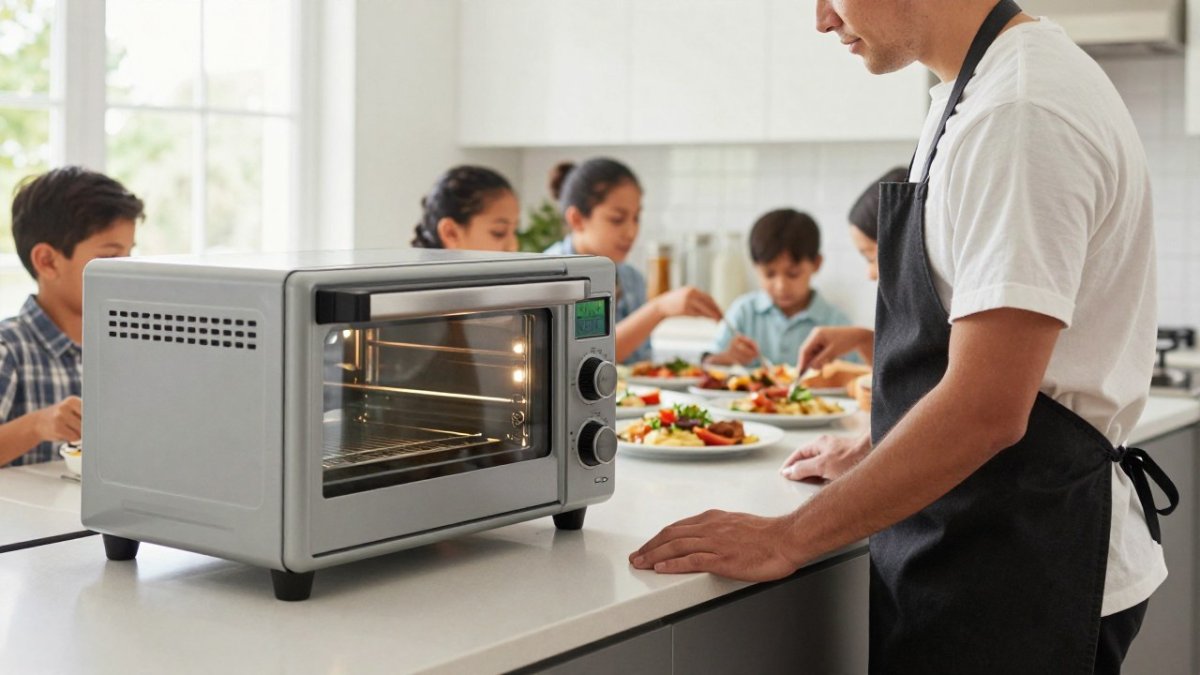
Best for: Households cooking small to medium meals most days, such as one or two people or quick weeknight dinners. Skip if: You regularly roast large cuts of meat or bake for a crowd, where a full-size oven will serve you better.
Shop our toaster oven and oven range at Fast Appliances LLC to compare wattage, chamber size, and convection options side by side. If you are ready to buy, you can also compare local appliance stores in Orlando before deciding where to purchase. Pricing depends on the model, quantity, dates, and delivery, so check the listing for the latest price and delivery details. Choosing the right size for your cooking habits will do more for your energy bill than any single feature.
Frequently Asked Questions
Do convection ovens use more electricity?
Not necessarily. A convection oven uses a fan to circulate hot air, which lets food cook at a lower set temperature or in less time, so the total energy per meal can be similar or lower than a conventional oven. The main energy draw is still the heating element. Smaller cooking chambers, like those in countertop units, heat up faster and lose less heat, which often makes them the more efficient choice for small meals. Your actual usage depends on the wattage listed on the unit and how long it runs.
How much electricity does a countertop oven use per hour?
A countertop oven typically draws between about 1,000 and 1,800 watts when the heating element is on, which works out to roughly 1 to 1.8 kilowatt-hours per hour of continuous use. Because the element cycles on and off to hold temperature, real use is often lower. Multiply the kilowatt-hours by your utility's rate to estimate cost. Check the rated wattage on the nameplate of your specific model, since figures vary by brand and size.
Does a smart oven use less energy than a convection oven?
Smart ovens can reduce energy use when their sensors end cooking early, adjust temperature automatically, or avoid unnecessary preheating. A conventional convection oven does not do this on its own. The savings depend on how the smart features are used and on the cooking task. Measuring a full cooking cycle in kilowatt-hours for each model is the most reliable way to compare them, and standby power should be included in the comparison.
Can smart oven features reduce electricity use?
They can, mainly by shortening cook times through sensor-based doneness detection, skipping or shortening preheat, and holding precise temperatures. Features that keep the display or Wi-Fi active add a small standby load, which is usually minor compared with heating. The practical benefit is most noticeable for small portions and frequent cooking. Track the energy use of a few typical meals to see whether the features help in your kitchen.