 listicle
7 Benefits of Using a Ventless Dryer in Apartments
Last Updated: October 29, 2026
Quick Summary
A ventless dryer removes moisture by condensing it into a reservoir or draining it away, so it needs no duct to the outside. This lets apartment renters and condo owners place a stackable or compact unit in a closet with just a power outlet and proper clearance, avoiding exterior vent installation.
- Vented dryers push humid air outside through a duct, while ventless units capture moisture internally.
- Ventless installation comes down to power, drainage, clearance, and level ground.
- Ventless drying cycles generally run longer than vented cycles, especially with larger or thicker loads.
- Empty the reservoir every cycle, or route a drain hose to a standpipe or laundry sink.
- Clean the lint filter after every cycle and the condenser on the manufacturer's schedule.
Table of Contents
- Why a Ventless Dryer Fits Apartment Living
- Ventless vs. Vented Dryer: What Actually Changes in an Apartment
- Ventless Dryer Pros and Cons for Apartment Owners and Renters
- Ventless Dryer Installation Requirements: The Apartment Checklist
- Ventless Dryer Drying Time and Real Operating Costs
- Managing Indoor Humidity and Moisture in a Small Apartment
- Choosing the Right Ventless Dryer for Your Space
- Ordering Your Ventless Dryer Set From Fast Appliances LLC
- Frequently Asked Questions
Why a Ventless Dryer Fits Apartment Living
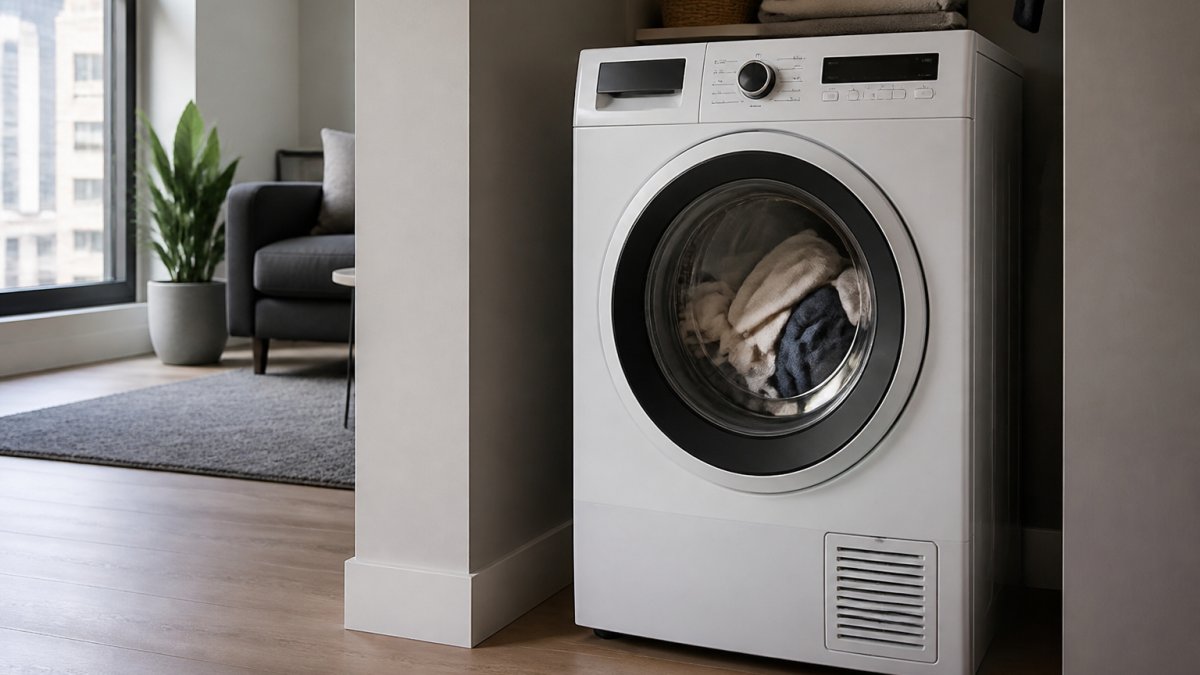
A ventless dryer is a dryer that removes moisture from clothes by condensing it into a reservoir or draining it away, so it needs no duct to the outside. That single design choice changes what is possible in an apartment.
The benefits of using a ventless dryer in apartments start with placement. You can stack it or tuck it into a closet, as long as it has a power outlet and the space meets the unit's clearance needs. No duct run means no drilling through brick or roof penetration.
Below, we break down how ventless and vented models actually differ, the real pros and cons, what installation demands, and how to pick the right unit for a small space. The goal is simple: help you decide before you buy, not after the delivery truck leaves.
Ventless vs. Vented Dryer: What Actually Changes in an Apartment
The core difference is where the moist air goes. A vented dryer pushes hot, humid air through a duct to the outdoors. A ventless dryer captures that moisture inside the machine, either condensing it into a container you empty or sending it down a drain line.
That distinction drives everything else:
- Placement: Vented units need an exterior wall or roof duct. Ventless units need only an electrical outlet and, ideally, a drain.
- Installation cost: Ductwork adds labor and materials. Ventless installation is closer to plugging in a large appliance.
- Moisture handling: Vented dryers expel humidity outside. Ventless dryers release far less into the room, which matters in a sealed apartment.
For a full comparison of washer and dryer configurations, including top-load versus front-load and gas versus electric, our washer and dryer buying guide walks through the trade-offs room by room.
Ventless Dryer Pros and Cons for Apartment Owners and Renters
Here is the honest split. Ventless dryers solve a specific problem well, but they are not a straight upgrade for every household.
Pros:
- No exterior vent required, so they work in interior closets and basements
- Installation flexibility: stackable, compact, and often able to sit where a vented unit cannot
- Lower-temperature drying, which many owners prefer for delicate fabrics
Cons:
- Longer drying cycles than most vented models
- A water reservoir you must empty, or a drain line you must route
- Condenser and lint filter cleaning is part of routine ownership
Landlords weighing durability and repair costs across multiple units will find more context in our guide to appliances for rentals and Airbnbs, which covers what tends to last and what saves money over a lease term.
Ventless Dryer Installation Requirements: The Apartment Checklist
Ventless dryer installation requirements come down to four things: power, drainage, clearance, and level ground. For a look at professional dryer installation: timeline and what to expect, see our article. Get those right and the install is usually straightforward.
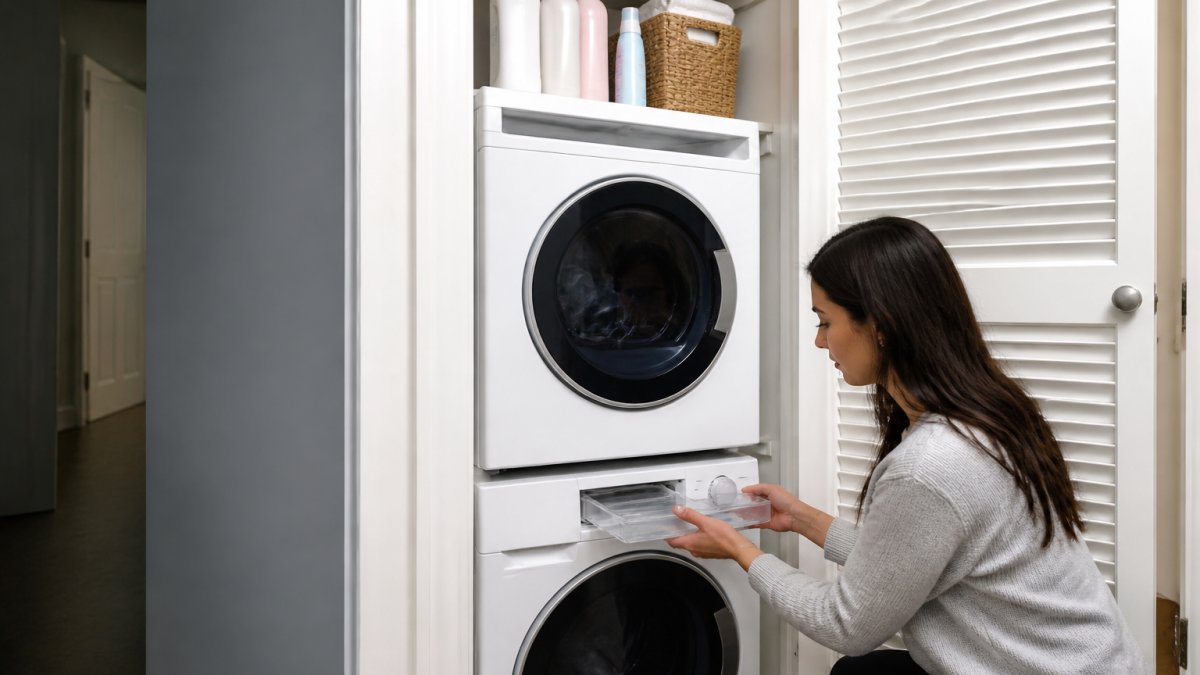
Run through this before you order:
- Confirm a dedicated 240V outlet for an electric dryer, or a gas line if you chose gas
- Measure the closet opening, including door swing and clearance behind the unit
- Decide between reservoir emptying and a drain connection
- Check the floor is level and can carry a stacked washer-dryer load
- Verify the unit's depth fits with the door closed
- Confirm building rules on appliance installation and water lines
Ventless Dryer Drying Time and Real Operating Costs
Ventless dryer drying time runs longer than a vented cycle, and that is the trade-off most buyers underestimate. Heat-pump and condenser models dry at lower temperatures, so a load that finishes in one cycle in a vented dryer may need a longer cycle or a second pass in a ventless one. The gap widens with load size, fabric thickness, and how well you maintain the filters.
Ventless drying cycles generally run longer than vented cycles, and the exact time shifts with the model, the load, and the spin speed of your washer, a high-spin washer extracts more water and shortens any dryer cycle.
How to estimate your operating cost
Operating cost depends on three inputs: your electricity rate, the dryer's wattage, and how many loads you run per week. You can build a defensible estimate without guessing at a specific model's price.
- Find your electricity rate. It is printed on your utility bill in cents per kilowatt-hour (kWh). Residential rates vary by region and season.
- Find the dryer's rated wattage. It is on the model's spec sheet or energy label. Heat-pump dryers generally recycle heat within the drum, which affects their energy use compared with other ventless designs.
- Convert to cost per cycle. Multiply wattage by cycle hours, divide by 1,000 to get kWh, then multiply by your rate.
To estimate your own cost, multiply the dryer's rated wattage by the cycle length, convert to kilowatt-hours, and multiply by your electricity rate. Check your spec sheet for the wattage and your utility bill for the rate.
Habits that keep ventless costs down
- Run full loads rather than partial ones, cost per pound of laundry drops as load size rises.
- Clean the lint filter after every cycle; a clogged filter stretches cycle time and wastes electricity.
- Keep the condenser clean per the manufacturer's schedule; lint and mineral film slow heat transfer.
- Use the moisture-sensor setting instead of timed drying so the machine stops when clothes are dry.
- Spin laundry at the highest speed your washer allows before drying.
Pricing depends on model, capacity, quantity, and delivery. For current prices or a quote, visit the Fast Appliances LLC website.
Managing Indoor Humidity and Moisture in a Small Apartment
Moisture is the issue that separates a good ventless experience from a bad one, and it is where most apartment guides stay vague. Here is the mechanism, then the controls.
How ventless dryers actually handle moisture
A ventless dryer does not vent humid air outside. Instead, it pulls moist air from the drum and passes it over a cold surface, the condenser, where water vapor condenses into liquid. That liquid drains into a reservoir you empty or into a drain line. Heat-pump models add a closed-loop refrigerant system that reheats the dried air and sends it back through the drum.
Even with that design, some humidity escapes into the room through door seals, the reservoir cavity, and the machine's own heat. In a small, sealed apartment, that residual moisture adds up over repeated cycles. The risk is highest in interior closets with no return-air path, in bathrooms without an exhaust fan, and in units where the dryer sits against an exterior wall that stays cold in winter, cold surfaces are where condensation forms first.
A concrete moisture-management protocol
- Empty the reservoir every cycle. A full reservoir forces the machine to work harder and can trigger shutoffs. If your model supports continuous drain, route the hose to a standpipe or laundry sink and skip this step entirely.
- Give the closet air movement. Leave the closet door open during and after cycles, or install a louvered door. A closed closet traps the residual humidity against cold walls.
- Run a bathroom fan or crack a window during cycles. Air circulation keeps indoor humidity in check and reduces mold risk in closets. In a sealed apartment, a small fan moving air across the doorway helps more than most people expect.
- Watch the cold spots. Check exterior walls, window frames, and the floor behind the unit for condensation after cycles. Persistent condensation means the room needs more air exchange, not a new dryer.
- Clean the condenser on schedule. Skipping condenser cleaning lets lint and mineral film build up, which slows drying and can leave clothes feeling damp, and damp clothes mean longer cycles and more residual humidity.
What raises indoor humidity beyond the dryer
Hanging damp clothes to finish drying, running a washer without a proper drain, and storing wet towels in the same closet all add moisture the dryer was never sized to handle. Keep the laundry closet for the machines and move air-drying to a bathroom with an exhaust fan.
Choosing the Right Ventless Dryer for Your Space
Match the model type to your space and habits before you compare specs.
| Model Type | Best For | Watch For |
|---|---|---|
| Heat-pump dryer | Efficiency-focused owners, frequent use | Higher upfront cost, longer cycles |
| Condenser dryer | Renters wanting simple setup | Reservoir emptying each load |
| Washer-dryer combo | Very tight spaces, one-unit footprint | Smaller load size per cycle |
| Compact ventless dryer | Small closets, stacking with a washer | Limited capacity for large loads |
Measure your space first, then your typical load size. A household doing high-volume laundry will feel a compact unit's limits fast. If you are furnishing a small apartment from scratch, our roundup of the best compact washing machine for small apartments pairs well with a ventless dryer pick.
Ordering Your Ventless Dryer Set From Fast Appliances LLC
Fast Appliances LLC carries washers, dryers, refrigerators, stoves, microwaves, dishwashers, cooktops, and ovens in one online catalog, so you can build a matching set without driving between stores. Delivery comes to your door, and our team can help you confirm dimensions and hookup needs before you order.
If you are weighing condition and warranty options, our breakdown of used vs. open-box vs. scratch-and-dent appliances explains what each label means before you commit.
Frequently Asked Questions
Can you use a ventless dryer in an apartment without a dryer vent?
Yes. A ventless dryer does not need an external vent because it removes moisture by condensing it into a water reservoir or draining it through a hose. You only need a standard electrical outlet, and for condenser or heat-pump models, a drain connection if you prefer not to empty the reservoir.
Are ventless dryers more energy-efficient than vented dryers?
Heat-pump and condenser ventless dryers both avoid exhausting warm air outdoors, and their electricity use depends on the specific model. Your actual electricity consumption depends on load size, cycle length, and how often you run the machine, so check the dryer's energy guide label and compare it against your typical weekly laundry volume.
How long does a ventless dryer take to dry clothes?
Ventless dryer drying time generally runs longer than a vented dryer, and the exact time depends on the model type, load size, and fabric. To keep cycles shorter, spin clothes at the highest safe speed in the washer, avoid overloading the drum, and clean the lint filter before every cycle.
Does a ventless dryer make a room humid or cause mold risk?
Ventless dryers collect most moisture in the reservoir or drain it away, though some humidity can still escape into the room. Small amounts of moisture can escape during a cycle, so run the bathroom or kitchen exhaust fan, leave the closet door open, and keep air circulation moving in tight spaces. Empty the water reservoir after each load and clean the condenser regularly to prevent mold risk and musty odors.
The right ventless dryer turns an impossible laundry closet into a working one. Fast Appliances LLC offers a wide variety of home appliances, direct online ordering, and delivery to your door, with a team ready to help you match capacity and hookups to your space. Get started with Fast Appliances LLC and build a laundry setup that actually fits your apartment.