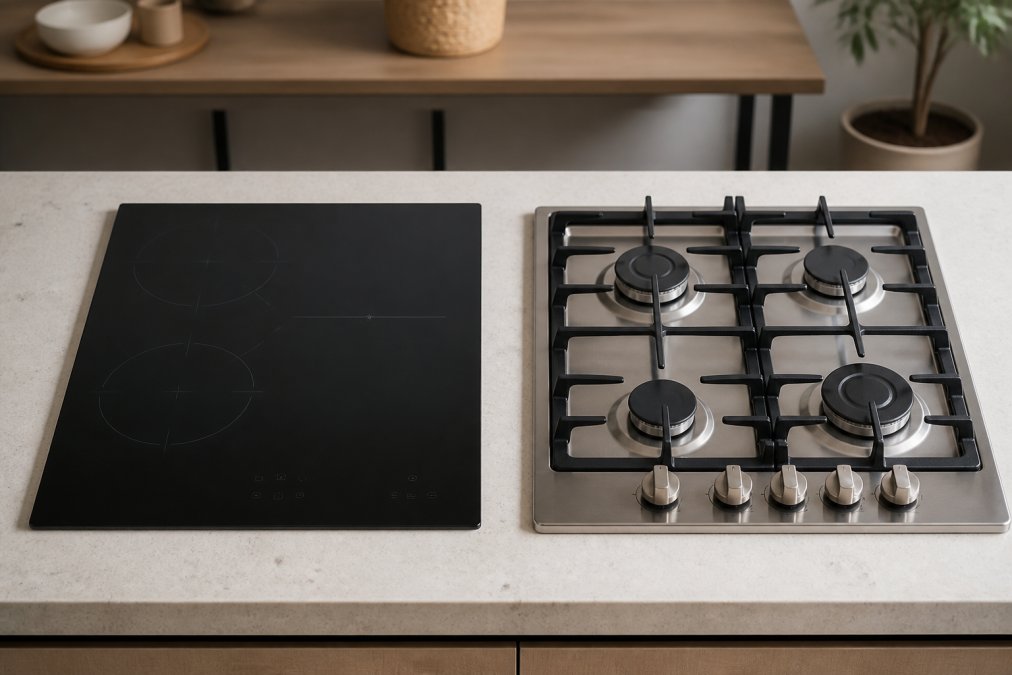
 comparison
Induction vs Gas Cooktop for Beginners
Table of Contents
- How Induction and Gas Cooktops Work
- Induction Cooktop Cookware Requirements
- Energy Efficiency of Induction vs Gas
- Ventilation Requirements for Gas Stoves
- Installation, Costs, and Retrofitting
- Safety, Cleaning, and Daily Use
- Which Cooktop Should You Choose?
- Frequently Asked Questions
Last Updated: September 18, 2026
How Induction and Gas Cooktops Work
Induction cooktops use electromagnetism to heat cookware directly, while gas cooktops rely on an open flame. Understanding how each technology works is essential for choosing the right induction vs gas cooktop for your kitchen.
Induction cooktops generate a magnetic field that induces electrical currents in ferromagnetic cookware, making the pan itself the heat source. The surface stays cool to the touch, heat transfer is nearly instant, and touch controls provide precise temperature adjustment.
Gas cooktops ignite natural gas to create an open flame that heats cookware through radiation and convection. Physical knobs control flame size, offering tactile feedback and visual confirmation of cooking temperature.
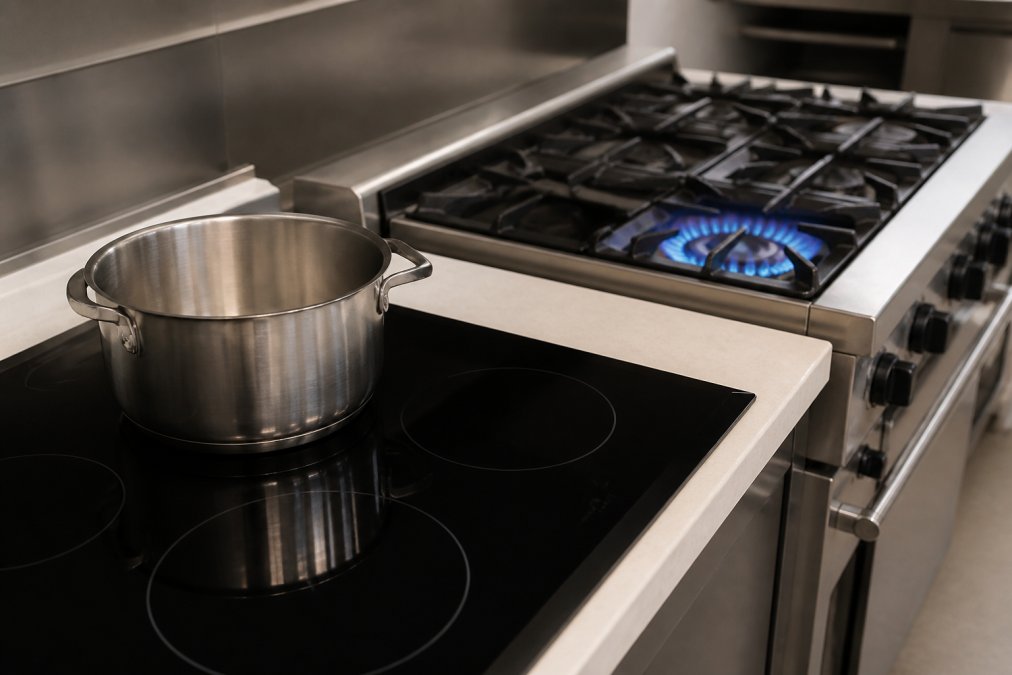
Induction cooktops boil water in roughly half the time gas requires. While gas produces higher peak BTU output, induction's direct heating eliminates wasted energy, appealing to busy households. Gas's proven reliability attracts traditionalists.
Induction cooktops require ferromagnetic cookware to activate, while gas cooktops work with any cookware type. This compatibility difference is a key consideration.
Induction Cooktop Cookware Requirements
Your cookware must be ferromagnetic for induction to work. If you own mostly aluminum or copper pans, you'll need to replace them.
Ferromagnetic cookware contains iron or steel that responds to magnetic fields. Cast iron is ideal; stainless steel works if it contains sufficient iron. Copper, aluminum, ceramic, glass, and non-magnetic stainless steel won't activate induction cooktops.
The Magnet Test: A Beginner's Guide
Hold a magnet to the bottom of each pan. If it sticks firmly, the cookware is induction-compatible. Most modern cookware is induction-ready, but older sets may not be.
Common cookware that fails the magnet test:
- Aluminum pans (very common in older kitchens)
- Copper-bottomed cookware
- Non-magnetic stainless steel (check the label; some premium brands use non-ferrous stainless)
- Vintage Revere Ware with copper bottoms
- Ceramic and glass cookware
- Anodized aluminum (popular in the 1990s-2000s)
Cookware Compatibility and Cost
Induction-compatible cookware costs no more than traditional options. A basic 10-piece stainless steel induction-ready set typically costs $80-$150, comparable to gas-compatible sets.
Look for cookware with a flat bottom for optimal heat transfer. If you already own flat-bottomed cast iron or stainless steel, you likely don't need to replace anything.
The Acoustic Profile: What Beginners Don't Expect
Induction cooktops produce a humming or buzzing noise (50-80 decibels) from magnetic coil vibration, which is normal and not a defect. Higher-end models have better acoustic dampening. If you're sensitive to kitchen noise, test an induction cooktop in-store before buying.
Energy Efficiency of Induction vs Gas
Induction cooktops transfer heat more efficiently than gas, resulting in shorter cooking times and lower energy bills. Gas cooktops heat surrounding air, dispersing energy into your kitchen. However, gas remains cheaper to operate in regions with low natural gas rates.
Induction produces zero combustion byproducts, while gas cooking releases carbon dioxide, carbon monoxide, and nitrogen oxides. Induction cooktops reach target temperatures faster, appealing to busy households.
Ventilation Requirements for Gas Stoves
Gas cooktops require ventilation to remove combustion byproducts safely. Most building codes require a range hood venting outside through ductwork.
Induction cooktops don't require ventilation for safety. Many homeowners install range hoods anyway to remove odors and steam, but it's optional, not a safety requirement like gas.
Gas cooktop ventilation adds installation cost; ductwork can run several hundred dollars. Induction's lack of ventilation requirements is an advantage for renovations in homes without existing range hoods.
Installation, Costs, and Retrofitting
Installing an induction cooktop requires a dedicated 240-volt electrical outlet. Most homes built after 1970 have this infrastructure, but electrical panel capacity is the real barrier for older homes.
The Hidden Electrical Panel Problem
Induction cooktops draw 30-50 amps at full power. If your panel has spare capacity and a 240V circuit runs to your kitchen, installation costs $200-$500. If your panel is at or near capacity, a panel upgrade costs $1,500-$3,000 or more.
Older homes (pre-1980) often have 100-amp service, which may be insufficient. Homes built 1980-2000 typically have 150-200-amp service, which usually accommodates induction. Newer homes almost always have adequate capacity.
Before buying an induction cooktop, have an electrician assess your panel. This inspection typically costs $75-$150 and tells you exactly what you're facing. Many homeowners discover they can install induction without major upgrades; others learn they need panel work and can budget accordingly.
Gas Cooktop Installation
Gas cooktops need a gas line connection. If your kitchen has existing gas infrastructure, installation costs $200-$400. New gas lines cost $800-$2,000+ depending on distance from the main meter.
Typical Retrofit Cost Scenarios
| Scenario | Induction | Gas |
|---|---|---|
| Existing 240V outlet, adequate panel capacity | $200-$500 | $200-$400 |
| No 240V outlet, panel upgrade needed | $1,500-$3,500 | $200-$400 |
| Existing gas line | $200-$500 | $200-$400 |
| No gas line, new line required | $200-$500 | $800-$2,000+ |
Hybrid Cooktops: A Middle Ground for Hesitant Beginners
Hybrid (dual-fuel) cooktops combine an induction surface with a gas oven, offering speed and safety for everyday cooking plus gas for baking. They cost $2,500-$5,000+ and require both 240V electrical service and a gas line, but eliminate the all-or-nothing decision.
Regional Cost Variation
Labor costs vary significantly by region. Urban areas typically charge 20-40% more than rural areas. Get multiple quotes from licensed professionals before budgeting.
Safety, Cleaning, and Daily Use
Induction cooktops stay cool during cooking, dramatically reducing burn risk in homes with children. Gas cooktops generate open flames and hot surfaces, requiring careful supervision in households with small children.
Induction's smooth glass surface wipes clean easily with a damp cloth. Gas cooktops have crevices around burners where food accumulates, requiring grate removal and scrubbing.
Induction cooktops cool almost instantly when you reduce power, appealing to precision-focused cooks. Touch controls offer child safety locks; gas cooktops rely on supervision to prevent accidental ignition.
Induction eliminates combustion byproducts that irritate airways. For families with respiratory sensitivities, this health benefit justifies the switch.
Which Cooktop Should You Choose?
Choose induction for speed, safety, and easy cleaning, but you need ferromagnetic pans and may need electrical upgrades. Choose gas for traditional flame cooking and cookware compatibility, but expect longer cooking times, more cleanup, and ventilation requirements.
For beginners, induction edges ahead on safety and convenience. Cookware replacement is the main barrier. For traditionalists with existing gas infrastructure, gas cooktops deliver familiar methods at lower upfront cost.
Fast Appliances LLC offers a comprehensive online selection of essential home appliances, including cooktops. Our wide variety and direct approach make it simple to find exactly what you need. Browse our selection online to compare models.
Frequently Asked Questions
Do I need special cookware for an induction cooktop?
Yes. Induction cooktops require ferromagnetic cookware, materials that respond to magnetic fields. Cast iron, stainless steel with magnetic bases, and enameled cast iron work well. Aluminum, copper, and glass cookware won't work unless they have a magnetic base layer. You can test existing pots with a magnet; if it sticks to the bottom, the cookware is compatible. Most cookware sold today includes induction-compatible options, but verify before purchasing if you're starting fresh.
Is induction cooking safer than gas cooking for families?
Induction cooktops offer distinct safety advantages for families. The surface heats only when compatible cookware is present, reducing accidental burns. There's no open flame, eliminating gas leak risks and reducing carbon monoxide concerns. Gas cooktops produce combustion byproducts that require proper ventilation, and the open flame poses burn hazards. However, induction surfaces do get hot from the cookware, so supervision remains important. Child safety locks are available on both types, but induction's lack of flame makes it inherently safer for households with young children.
How does induction cooking compare to gas in terms of energy efficiency?
Induction cooktops are significantly more efficient than gas. Induction transfers energy directly to cookware through electromagnetism, with 80-90% efficiency rates. Gas cooktops lose substantial heat to the surrounding air and require ventilation, achieving only 65-75% efficiency. This means induction heats food faster, uses less electricity, and reduces kitchen ambient temperature. Over time, the energy savings can offset induction's higher upfront cost, especially in regions with higher energy rates. Gas remains cheaper to operate in areas with low natural gas prices.
What are the main downsides of switching to an induction cooktop?
The primary drawbacks include higher initial purchase cost, the requirement to replace incompatible cookware, and installation complexity if you lack a 240-volt outlet. Induction cooktops can produce a low humming or buzzing sound, which some find distracting. They also lack the visual feedback of an open flame, some experienced cooks prefer seeing the flame to judge heat level. Additionally, induction surfaces can be damaged by dragging heavy pots or dropping metal objects. Finally, if you have an older home without adequate electrical capacity, upgrading your electrical panel adds significant retrofitting expense.
Which cooktop type is better for beginners?
Induction cooktops are often better for beginners because they offer faster, more precise temperature control and are easier to clean. The touch controls respond immediately, and the surface cools quickly once cookware is removed. Gas cooktops suit beginners who already have a gas line, prefer the tactile feedback of flame control, and want lower upfront costs. Your choice depends on your kitchen setup, budget, and cooking preferences. If you're renovating or installing new, induction's safety features and efficiency make it ideal for first-time buyers. If you already have gas infrastructure and prefer traditional methods, gas remains practical and reliable.
Choosing between induction and gas cooktops feels overwhelming until you focus on what matters: your home's electrical or gas infrastructure, your existing cookware, and whether you prioritize speed or tradition. Fast Appliances LLC offers both technologies with expert guidance to match your kitchen's unique needs. Explore our cooktop selection and find the right fit for your home today.