 listicle
Top 10 Professional Gas Stoves for Home Kitchens
Table of Contents
- Quick Comparison Table
- How to Choose a Professional Stove
- Best Overall Professional Gas Stove: Wolf 30" Gas Range
- Best Value Professional Gas Range: Whirlpool WFG505M0BS
- Best Professional-Style Range: Bertazzoni PRO304BFGMBIT
- Gas Range vs Dual Fuel Range: Which Performs Better
- Professional Gas Range Installation Requirements
- Other Top Contenders Worth Considering
- Frequently Asked Questions
Last Updated: September 26, 2026
Quick Comparison Table
| Range Model | Best For | Key Feature | Installation Type |
|---|---|---|---|
| Wolf 30" Gas Range | Serious home chefs | Dual-stacked burners, infrared broiler | Slide-in or freestanding |
| Whirlpool WFG505M0BS | Budget-conscious families | SpeedHeat burners, cast iron grates | Freestanding |
| Bertazzoni PRO304BFGMBIT | Italian design lovers | 4.7 cu ft oven, brass burners | Slide-in |
| GE GGF600AV | Modern kitchen integration | Edge-to-edge cooktop, convection | Slide-in |
| LG LSGL583CF | Tech-savvy households | 5.8 cu ft capacity, smart connectivity | Freestanding |
| Forno Lazio 30" Dual Fuel | Precision bakers | Gas burners + electric convection | Requires 240V |
| ZLINE Autograph Edition | Design-focused kitchens | Hand-cast burners, color options | Slide-in or freestanding |
| Thermador Pro Harmony | Simmer control enthusiasts | Star Burner design, ExtraLow simmer | Requires professional install |
| Monogram 30" Professional | Luxury kitchen remodels | High BTU output, WiFi-enabled | Slide-in |
How to Choose a Professional Stove
Selecting a professional gas stove depends on your cooking style, kitchen layout, and budget.
Evaluate your cooktop needs: high-heat burners for searing or low-temperature simmering? Professional gas stoves range from 5,000 BTU simmer burners to 20,000 BTU power burners. Varied burner sizes provide flexibility for entertaining or cooking multiple dishes simultaneously.
Consider oven capacity (4.5-5.8 cubic feet for most home cooking) and convection options for even heat distribution if you bake regularly.
Slide-in ranges integrate seamlessly with cabinetry; freestanding ranges offer more placement flexibility. Professional-style ranges require special ventilation and gas line configurations, so budget for installation costs beyond the appliance price.
Best Overall Professional Gas Stove: Wolf 30" Gas Range
The Wolf 30" Gas Range represents the gold standard for serious home cooks. Its dual-stacked sealed burners deliver unmatched temperature precision for simmering or high-heat cooking.
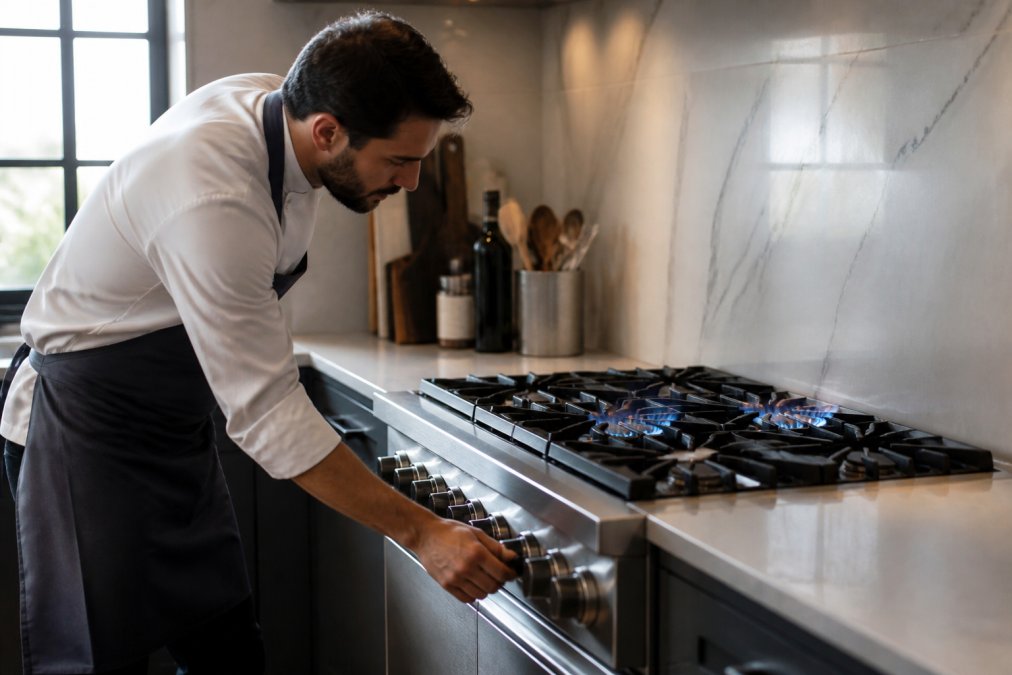
The infrared broiler delivers intense, even heat for finishing steaks or melting cheese. Dual-fan convection ensures consistent baking across multiple racks.
Ergonomic red control knobs enable precise adjustments, and sealed burners prevent spills from reaching the cooktop interior, reducing cleaning time and extending longevity.
Wolf ranges represent a substantial investment, but temperature control precision justifies the cost through fewer ruined dishes and consistent baking results.
Best Value Professional Gas Range: Whirlpool WFG505M0BS
The Whirlpool WFG505M0BS delivers professional-style cooking at an accessible price. This freestanding range prioritizes core functionality and reliability over advanced features.
SpeedHeat burners boil water faster, and cast iron grates provide durability and even heat distribution. A large oven window lets you monitor progress without opening the door.
AccuBake temperature management maintains consistent oven temperature, reducing undercooked centers or burnt edges when baking multiple batches.
Trade-offs include no dual convection fans, self-cleaning cycles, or smart connectivity. Oven capacity is smaller than professional-tier models, and the cooktop lacks sealed burners.
This range makes sense if you cook regularly but don't need commercial-grade features. It's durable, straightforward to operate, and requires minimal maintenance.
Best Professional-Style Range: Bertazzoni PRO304BFGMBIT
The Bertazzoni PRO304BFGMBIT combines Italian engineering with practical performance, appealing to cooks who value aesthetics alongside functionality.
Four brass burners deliver responsive heat control and long-term reliability. The 4.7 cubic foot oven with dual convection fans handles large roasts and multiple sheet pans without hot spots.
Soft-motion hinges reduce wear, and edge-to-edge cast iron grates create a professional appearance with flexible cookware placement.
The PRO304BFGMBIT occupies a middle ground between entry-level and ultra-premium models, offering genuine professional features without the highest-tier investment.
Gas Range vs Dual Fuel Range: Which Performs Better
The choice between gas-only and dual fuel ranges depends on your cooking priorities, baking habits, and long-term maintenance expectations. While performance differences are well-documented, the hidden costs of ownership often determine which option makes financial sense.
Gas-only ranges excel at stovetop cooking with instant heat response and precise temperature control. Professional chefs prefer gas burners for sautéing, searing, and wok cooking, though gas ovens can develop hot spots.
Dual fuel ranges pair gas burners with electric convection ovens, addressing gas ovens' uneven heat distribution. Electric convection produces superior baking results and reduces cooking time by 15-25%, benefiting households that bake regularly.
Performance trade-offs and complexity matter significantly. Dual fuel ranges require both gas and 240V electrical connections, involving both plumber and electrician. Maintenance involves two systems: convection fan motor replacement costs $300-$600; gas ignition repair runs $150-$400.
Long-term maintenance costs represent the largest hidden difference. Gas-only ranges have standardized parts (burner caps $15-$30, knobs $20-$50, grates $40-$80) and service calls average $150-$250. Dual fuel ranges require specialized technicians ($250-$400 service calls) and non-standardized parts ($400-$800 for convection assemblies). Over 10 years, gas-only ranges cost $800-$1,500 in maintenance; dual fuel ranges cost $1,800-$3,200.
Most gas-only ranges carry 3-year warranties; dual fuel ranges offer 3-year gas coverage and 1-year electric coverage. Extended warranties cost $400-$800 for dual fuel versus $200-$400 for gas-only.
Cook stovetop meals 5+ days weekly but bake occasionally? Gas-only ranges deliver superior value with lower maintenance. Bake weekly or more? Dual fuel's electric convection justifies added complexity through consistent results and reduced ingredient waste. Forno Lazio's dual fuel models offer gas burner performance with precise baking, though budget an additional $100-$150 annually for maintenance.
Professional Gas Range Installation Requirements
Proper professional gas stove installation ensures safety, optimal performance, warranty compliance, and addresses hidden infrastructure demands.
Gas supply line compatibility matters first. Standard residential lines handle 40,000-60,000 BTU; a 120,000 BTU range needs a larger line. Upgrades cost $150-$400 depending on diameter and routing.
Ventilation requirements are critical for safety and code compliance. Most professional ranges require 600+ CFM; high-output models demand 900+ CFM. Calculate required CFM by multiplying total BTU by 1 CFM per 100 BTU (a 120,000 BTU range needs 1,200 CFM minimum). Many existing hoods (300-500 CFM) are inadequate, requiring new ventilation system installation at $2,000-$8,000. Consult your local building department before purchasing.
Electrical connections matter even for gas-only ranges. Electronic ignition systems, convection fans, and control panels require standard 120V power. Ensure a dedicated outlet exists near your range location. Dual fuel ranges and smart-enabled gas ranges require 240V service, requiring electrician involvement. This is where many homeowners encounter unexpected costs: if your kitchen lacks a 240V circuit, electrician installation runs $500-$1,500 depending on distance from your electrical panel and whether the panel has available capacity. Some older homes require panel upgrades (adding $1,000-$3,000) before a 240V circuit can be installed.
Smart-enabled gas ranges present a unique consideration: they require both gas supply and 240V electrical service, plus WiFi connectivity. Ensure your kitchen has reliable WiFi signal strength before committing to a smart model. Some homeowners must install WiFi extenders ($50-$200) to achieve stable connectivity for remote monitoring features.
Clearance and ventilation spacing prevents overheating and fire hazards. Professional gas stoves typically need 6 inches of clearance from side walls and 24 inches from the back wall. Some models require 30 inches of rear clearance for proper heat dissipation. Verify these requirements match your kitchen layout before purchasing, retrofitting clearance after installation is costly and sometimes impossible in tight kitchen layouts.
Gas line shutoff valve installation provides safety and convenience. A valve near the range allows quick gas shutoff if needed. This is a code requirement in most jurisdictions and typically costs $50-$150 to install.
Professional installation costs typically range $200-$500 for gas-only ranges and $400-$800 for dual fuel models, depending on complexity.
Other Top Contenders Worth Considering
Beyond the primary recommendations, several other professional gas stoves merit consideration depending on your specific needs.
Frequently Asked Questions
What makes a professional gas stove different from a standard range?
Professional gas stoves deliver higher BTU output (typically 15,000-20,000 BTU per burner), sealed burners that resist spills, heavy-duty cast iron grates, and superior temperature precision. They also feature convection ovens with multiple racks, larger oven capacities, and durable construction designed for frequent use. Standard ranges offer basic functionality for everyday cooking, while professional models prioritize control, durability, and cooking performance.
Do professional gas ranges require special ventilation?
Yes. Professional gas ranges with high BTU burners produce more heat and combustion byproducts than standard ranges. You'll need a ventilation hood with adequate CFM (cubic feet per minute) rating, typically 600+ CFM for gas cooking. High-output burners (18,000+ BTU) may require 900+ CFM. Proper ventilation removes heat, moisture, and odors while maintaining indoor air quality. Consult your range's specifications and local building codes before installation.
What's the difference between a gas range and a dual fuel range?
A gas range uses gas burners and a gas oven. A dual fuel range combines gas burners with an electric convection oven, offering the best of both: precise, responsive gas cooking and the even heat distribution of electric convection baking. Dual fuel ranges cost more and require 240V electrical connection, but they're ideal for serious bakers who want gas cooking power with electric oven accuracy.
How do I know if my kitchen can support a professional gas stove?
Check for: existing gas line (or budget for installation), adequate ventilation capacity, proper electrical supply (240V if dual fuel), clearance space for the range dimensions, and kitchen cabinetry depth (typically 24-25 inches for slide-in models). Review your range's installation manual and consult a licensed gas fitter or electrician. Many professional stoves require professional installation to ensure safety and warranty compliance.